
Division 23 – HVAC
Revised – 2026.01.27
Please also refer to “Part IV – REGULATORY REQUIREMENTS” for additional requirements.
Housing and Dining Facilities (HDS) has adopted amendments for all HDS facilities. Confirm applicable standards with Project Representative on a per Project basis.
Refer to HDS amendments within each section below.
TABLE OF CONTENTS – DIVISION 23 – HEATING, VENTILATION, AND AIR–CONDITIONING
23 00 00 – GENERAL INFORMATION
23 05 00 – COMMON WORK RESULTS FOR HVAC
23 07 00 – HVAC INSULATION
23 08 00 – COMMISSIONING OF HVAC
23 09 00 – INSTRUMENTATION AND CONTROL FOR HVAC
23 11 00 – FACILITY FUEL PIPING
23 13 00 – FACILITY FUEL–STORAGE TANKS
23 20 00 – HVAC PIPING AND PUMPS
23 21 00 – HYDRONIC PIPING AND PUMPS
23 22 00 – STEAM AND CONDENSATE PIPING AND PUMPS
23 23 00 – REFRIGERANT PIPING
23 25 00 – HVAC WATER TREATMENT
23 30 00 – HVAC AIR DISTRIBUTION
23 31 00 – HVAC DUCTS AND CASINGS
23 33 00 – AIR DUCT ACCESSORIES
23 34 00 – HVAC FANS
23 35 00 – SPECIAL EXHAUST SYSTEMS
23 36 00 – AIR TERMINAL UNITS
23 37 00 – AIR OUTLETS AND INLETS
23 38 00 – VENTILATION HOODS
23 41 00 – PARTICULATE AIR FILTRATION
23 51 00 – BREECHINGS, CHIMNEYS, AND STACKS
23 52 00 – HEATING BOILERS
23 53 00 – HEATING BOILER FEEDWATER EQUIPMENT
23 57 00 – HEAT EXCHANGERS FOR HVAC
23 61 00 – REFRIGERANT COMPRESSORS
23 64 00 – PACKAGED WATER CHILLERS
23 65 00 – COOLING TOWERS
23 72 00 – AIR–TO–AIR ENERGY RECOVERY EQUIPMENT
23 73 00 – INDOOR CENTRAL–STATION AIR–HANDLING UNITS
23 74 00 – PACKAGED OUTDOOR HVAC EQUIPMENT
23 76 00 – EVAPORATIVE AIR–COOLING EQUIPMENT
23 81 00 – DECENTRALIZED UNITARY HVAC EQUIPMENT
23 82 00 – CONVECTION HEATING AND COOLING UNITS
23 84 00 – HUMIDITY CONTROL EQUIPMENT2
23 00 00 – GENERAL INFORMATION
A. This standard applies to mechanical systems within buildings and associated heating cooling equipment.
B. Coordinate this standard with all other CSU Construction Standards.
1. Refer to especially Division 21 – Fire Suppression, Division 22 – Plumbing, Division 26 – Electrical, Division 27 – Communications, and Division 33 – Utilities.
2. All incoming building energy sources for mechanical heating and cooling systems must be metered. This includes power, steam, heating water, chilled water, and natural gas.
3. Refer to CSU Construction Standards 33 59 00 – Hydrocarbon Utility Metering, 33 61 33 – Hydronic Energy Distribution Metering, 33 63 33 – Steam Energy Distribution Metering, and 33 71 73 – Electrical Utility Services with associated drawing details of meter installations.
C. Life–Cycle Cost:
1. In general, Systems shall be designed and selected to optimize both first cost and life cycle cost.
2. New facilities and major renovations shall be designed without the need for natural gas to provide comfort or domestic water heating, when feasible.
a. Contact Project Representative to discuss a variance if alternative energy sources are not available.
3. Systems with fewer pieces of larger, centralized equipment shall be given consideration over numerous pieces of distributed equipment.
a. Equipment of higher quality and longer service life shall be given consideration over equipment of lower quality.
4. One of the largest components of building lifecycle cost is operation and maintenance. To reduce this cost, design of the building HVAC shall consider:
a. Locating equipment within the conditioned building envelope in dedicated mechanical rooms or provide chases, which allow full maintenance personnel access with dedicated doorways.
i. Avoid rooftop equipment to reduce long term roofing costs, ease maintenance of equipment, and to maximize area available for rooftop solar.
ii. Ground based is easier to access but consideration shall be given to architectural/landscape concerns.
iii. Provide space for additional equipment, which could be added in the future.
b. Height: Where possible, equipment and components shall be located at a height which does not require ladders to access for maintenance purposes.
i. If elevated installation is required, design for access utilizing standard 6’–0” step ladders.
ii. Where components requiring frequent access are over 12’–0” above finished floor, special maintenance accommodations will be provided.
iii. For example, mezzanines and catwalks.
c. In order of preference, location of equipment is:
i. In a dedicated mechanical room at maximum 6’–0” above the floor
ii. In accessible chases
iii. Other parts of the building exposed to view being easily visually inspected, repaired, and replaced
iv. Above Lay–In Ceiling Systems with maximum 24”x24” size titles,
v. Hard lid ceilings and walls with minimum 30”x30” access panels where possible
vi. Ground–level locations, roof–based locations
d. If possible, do not locate equipment requiring routine maintenance in or above occupied spaces.
e. Coordination shall be required with other trades and building components.
i. For example, VAV box access shall not be blocked by ceiling lighting or piping.
f. Provide adequate clearance around equipment for maintenance, repair, and replacement.
g. Consider safety of operations and maintenance personnel in all installations.
i. This includes hazards due to falling, proximity to rotating equipment, and exposure to toxic chemicals.
h. Utilize district energy sources where available such as chilled and heating water, and steam.
i. Refer to Division 33 – Utilities.
D. Design Conditions:
1. For normal applications at Fort Collins campuses, utilize the following outdoor design conditions and coordinate with the Project Representative.
a. Cooling:
i. 98 °F dry bulb and 62 °F wet bulb
b. Heating:
i. –5 °F dry bulb
c. The outdoor design conditions for evaporative cooling and cooling tower sizing shall be 91 °F dry bulb and 68 °F wet bulb.
2. For other locations utilize ASHRAE Fundamentals, Latest Edition Climate Design Data, 1% DB/MCWB for cooling, and 99% DB for heating, 0.4% WB for evaporative cooling.
3. For indoor design calculations, the following conditions shall be used for most campus buildings for the purpose of calculating heating and cooling loads and selecting equipment size and capacities except where other requirements exist such as computer rooms, animal laboratories or research labs.
a. Cooling:
i. 72 °F dry bulb
b. Heating:
i. 72 °F dry bulb
4. Humidity control shall not be provided except when specifically required by the program plan.
a. Plant steam may be used only for generation of clean steam served by a softened domestic water source.
5. Heat loss and gain calculations for representative spaces (classrooms, offices, labs, conference rooms, etc.) shall be submitted at Design Development for Project Representative review.
6. Any areas within the building envelope which contain pressurized water systems including wet–pipe sprinklers, domestic, industrial, and pure water systems shall be maintained above 40 °F.
a. Areas of special concern are entry vestibules and stairwells.
b. Preferred is utilization of the building heating system combined with means of transferring heat to spaces subject to freezing such as transfer grilles or ductwork.
c. Avoid active heating systems such as heat trace.
i. When required, provide two redundant cables each supplying from opposite ends so that a break does not leave any equipment or piping unprotected.
ii. Each cable shall be commissioned independently with independent power sources.
iii. Heat trace shall control from equipment/piping surface temperature, not outdoor air.
iv. Each heat trace system shall equalize runtime via the Building Automation System (BAS) and be independently alarmed to the BAS.
E. Equipment Sizing, Capacity, Access, and Efficiency:
1. Where feasible, HVAC equipment including duct mains and hydronic mains, shall have excess capacity for future expansion.
a. Buildings or building additions with an area of 50,000 gross square feet or less shall incorporate 5% excess capacity.
b. Buildings or building additions with an area of between 50,000 and 100,000 gross square feet shall incorporate 10% excess capacity.
c. Buildings or building additions with an area greater than 100,000 gross square feet, or a science building of any size, shall incorporate 20% excess capacity.
2. Where loss of building heating or cooling could result in significant financial loss including research, housing, dining, material, or payroll the following HVAC equipment requires N+1 redundancy:
a. Building steam–to–hot water heat exchangers
b. Building heating water circulation pumps
c. Building chilled water circulation pumps
d. Building heating boilers
e. Building chillers
3. Animal Holding Areas:
a. Laboratory animal holding areas shall be environmentally conditioned by separate Systems independent of Central Systems to conform to the latest edition of “Guide for the Care and Use of Laboratory Animals” published by National Institute of Health (NIH), current edition.
b. Coordinate with Lab Animal Resources to ensure all regulatory requirements for lab animal holding facilities are satisfied.
c. Sewage solids from animal facilities shall be reduced in size to match strainers on floor drains.
i. Bedding material for animals shall not be flushed down floor drains but disposed of in proper containers.
4. Biohazard Areas and Systems:
a. Biosafety Level Facilities shall be designed and operated in accordance with the “Biosafety in Microbiological and Biomedical Laboratories”, published by the U.S. Department of Health and Human Services, current edition.
b. Coordinate with the University Biosafety Office to ensure all regulatory requirements for Biosafety Level facilities are satisfied.
5. Fume Hood Exhaust Systems:
a. Lab Ventilation Design Level (LVDL) shall be assigned to the area served by the System and documented in the project Basis of Design (BOD).
b. LVDL shall include all assumptions affecting sizing of the fume hood exhaust system including redundancy, capacity, diversity, the need for dispersion modeling, etc.
c. Provide future capacity as noted in Section 23 35 00 – SPECIAL EXHAUST SYSTEMS.
6. Energy Conservation:
a. When specifying equipment, controls, and operation sequences, energy conservation shall be prioritized.
b. Colorado State University’s (CSU) minimum building performance design standard is for energy savings 20% better than the baseline building as defined in ASHRAE 90.1, current edition.
c. Buildings should also be designed to comply with the performance criteria outlined in Regulation 28 from the Colorado Air Quality Control Commission regarding Building Benchmarking and Performance Standards.
i. This regulation outlines specific Energy Use Intensity (EUI) targets by Building Type.
7. Equipment Rooms:
a. Mechanical equipment rooms shall be located on ground or basement floors with separate entrances away from main building entrance.
b. Mechanical rooms shall be separate from electrical equipment rooms.
i. Access to these rooms shall be limited to authorized maintenance personnel only.
ii. Equipment requiring access by building or laboratory personnel shall be housed separately.
iii. Any exceptions shall have prior approval from Facilities Management (FM) through Project Representative.
iv. Access to equipment rooms shall be arranged so entry will not disturb the occupants or normal functions of the building.
v. Outside access doors are preferable. Door sizes shall match the largest equipment size.
vi. Adequate heights shall be provided for walking and moving equipment into and out of room.
c. As required by codes, Alarm Systems shall be installed to detect presence of hazardous substances such as refrigerant gases.
i. Such Alarm Systems shall be integrated with the campus fire alarm/life safety system.
d. Equipment rooms shall be arranged and located so that heat and sound will not be transmitted to other parts of the building.
i. Adequate insulation and ventilation is required where applicable.
e. Equipment having parts which must be removed for maintenance (filter, coils, fan shafts, tube bundles, etc.) shall be located so that removal may be accomplished with adequate access and without interference to the operation of other equipment.
f. Provide floor drains.
g. When located above an occupied area, surround the room with a 6” curb, a 2” fiber cant, and waterproof the floor.
h. When chemicals will be stored in an equipment room, provide a secondary containment unit designed for chemical storage containers.
i. Provide high water detection alarms in all mechanical and equipment rooms at lowest point of floor.
i. Provide a 3/4” conduit between high water alarm and BAS panel for remote alarm to central read back system.
j. Equipment rooms and air handler interiors shall have a safe level of lighting.
k. Lifting eyes and hoisting rails shall be permanently placed to aid in lifting and removal of mechanical equipment weighing over 200 pounds.
l. Provide a minimum of one duplex GFCI electrical outlet on a dedicated circuit with others as necessary for service of equipment.
8. Pipe and Duct in Chases:
a. Provide 25% excess horizontal and vertical space in duct chases and pipe runs for future use.
b. Provide adequate access openings to pipe and duct chases for service and maintenance.
9. Pipe and Duct Penetrations:
a. The manner in which pipes pass through roofs, walls, floors, and ceilings must be specified or detailed.
i. The Contractor’s responsible for cutting or drilling holes and flashing, sealing, or otherwise furnishing them must be clearly designated.
b. Clearance above drop ceiling grid shall be a minimum of 6” to facilitate replacement and/or removal of ceiling panels.
c. Pipe and duct penetrations shall be designed so that minimum opening remains after installation.
i. Such openings shall be effectively sealed to prevent passage of rodents, birds, bugs, fire and smoke.
d. Where insulated pipe and duct passes through such openings the design shall provide for continuous insulation through the openings.
e. All penetrations that deviate from the plans require field approval by FM through the Project Representative.
f. Provide tubing or pipe (not sheet metal) sleeves for all utility services passing through structural walls and slabs.
i. All sleeves passing through slab floors shall project a minimum of 4” above the slab and be sealed watertight to the slab.
10. Access Doors:
a. Equipment and components shall not be placed above hard–lid ceilings.
b. Access doors shall be a minimum of 30” x 30” and subject to 900 sq. inch access.
c. Access doors of sufficient size for maintenance must be provided for all valves, traps, strainers, cleanouts, dampers, damper operators, concealed expansion joints, water hammer arrestors, switches, or any other equipment requiring service or maintenance.
d. For access to equipment that requires a ladder or lift, access doors shall accommodate these applications.
e. Access doors for inspection of air ducts, valves, sensors, actuators and devices are required.
i. Select several locations to provide a general inspection.
ii. Ceiling and wall access doors shall not have keyed locks.
23 05 00 – COMMON WORK RESULTS FOR HVAC
A. Common Motor Requirements for HVAC Equipment:
1. Provide motors for operation at 5,000’ elevation.
2. Motors shall be 3 phase where possible.
a. Motors 3/4 hp and smaller can be single phase.
b. Larger than 3/4 hp shall be 3 phase.
3. All motors of 1–1/2 hp and larger shall be at least IEC–3 premium efficiency as classified in the latest edition of the standard International Electrotechnical Commission (IEC).
a. Refer to Division 26 – Electrical for more information.
4. Where possible, motor speeds for pumps shall not exceed 1750 rpm.
5. Over–speeding motors by operating a VFD at greater than 60 Hz is not allowed.
6. All motors specified for VFD operations shall have rotor grounding devices installed.
a. Refer to Division 26 – Electrical for more information.
7. Motor frames shall be equipped with two axis adjustments, namely slotted frame ends for adjusting in shaft direction and adjusting screws for belt tensioning.
8. Installations shall be checked for “soft foot” conditions and shimmed appropriately.
9. Acceptable Manufacturers:
a. Baldor
b. Weg
c. Or approved equal
B. Expansion Fittings and Loops for HVAC Piping:
1. Pipes and equipment shall be arranged with due regard for the effects of thermal expansion.
2. Piping and joints shall be designed to eliminate damage by expansion and contraction.
3. Mechanical expansion devices are discouraged.
a. Expansion loops are preferred.
b. Where mechanical expansion devices are necessary, bellows type shall be specified.
c. Other types with mechanical seals are not permitted.
C. Meters (non–utility) and Gages for HVAC Piping:
1. Provide isolation ball valves at all gauges for removal under operation.
2. A single, common pressure gauge with suitable range shall be employed across pumps, strainers, pressure reducing stations, etc., with multiple taps into piping and individual isolation valves.
3. Alcohol filled or dial thermometers are acceptable.
a. Typical sizes shall be 9” bulb type with swivel joints to be located in matching thermal wells.
b. Direct insertion type thermometers are not permitted.
4. Provide pressure manometers across main building air filters.
a. HDS – Not required
5. Provide gauges, thermometers, and pressure/temperature taps on supply and return piping at all heat exchangers.
6. Provide thermometers and pressure/temperature taps on supply and return piping at all coils.
7. Provide gauges and pressure/temperature taps on supply and return piping at all pumps.
8. Gages and thermometers shall be placed such that they are readable from floor level.
D. General–Duty Valves for HVAC Piping:
1. Acceptable Products:
a. Ball Valves:
i. Hydronic:
a) Apollo
b) Crane
c) Nibco
d) Stockham
e) Walworth
f) Or approved equal
ii. Steam:
a) Inline 202oF
b) Anix 1000
c) Valtorc 101
d) Or approved equal
iii. Condensate:
a) Inline 202oF
b) Or approved equal
iv. Natural Gas:
a) Apollo
b) Crane
c) Nibco
d) Stockham
e) Walworth
f) Or approved equal
b. Butterfly Valves:
i. Hydronic:
a) DeZurik
b) Jamesberry 830L or 815L
c) Keystone
d) Milwaukee
e) Or approved equal
ii. Steam:
a) Jamesberry
b) Keystone K–LOK Model 362 with lugged carbon body, 316ss disc and seat and gear actuator with hand wheel
c) Vanessa 30,000 or 32,500 series
d) Or approved equal
iii. Condensate:
a) Jamesberry
b) Keystone K–LOK Model 362 with lugged carbon body, 316ss disc and seat and gear actuator with hand wheel
c) Vanessa 30,000 or 32,500 series
d) Or approved equal
c. Gate Valves:
i. Hydronic:
a) Not allowed
ii. Steam:
a) Crane
b) Jenkins
c) Lunkenheimer
d) Milwaukee
e) Stockham
f) Walworth
g) Or approved equal
iii. Condensate:
a) Crane
b) Jenkins
c) Lunkenheimer
d) Milwaukee
e) Stockham
f) Walworth
g) Or approved equal
d. Globe Valves:
i. Hydronic:
a) Not allowed (except for balancing)
ii. Steam:
a) Crane
b) Jenkins
c) Lunkenheimer
d) Milwaukee
e) Stockham
f) Walworth
g) Or approved equal
iii. Condensate:
a) Crane
b) Jenkins
c) Lunkenheimer
d) Milwaukee
e) Stockham
f) Walworth
g) Or approved equal
e. Plug Valves:
i. Natural Gas:
a) Valves and specialty components shall be listed for the appropriate flammable gas/fluid application and system pressure.
b) Gas valves shall be listed to UL, American Gas Association (AGA), CSA International, and the American Society of Mechanical Engineers (ASME) standards, as applicable.
c) Valves at gas service shall be wrench operated.
d) Plug valves shall be non–lubricated type.
f. Integral Balance and Flow Measuring:
i. Hydronic:
a) Armstrong
b) Bell & Gossett
c) Tour & Andersson
d) FDI
e) Or approved equal
g. Check Valves:
i. Hydronic:
a) None listed
ii. Condensate 2–1/2” and smaller:
a) In–line spring type
b) Stainless 316 construction throughout with threaded connections.
c) Manufacturers:
i. DFT SCV
ii. Watson McDaniel WSSCV
iii. Or approved equal
iii. Condensate 3” and larger:
a) Wafer style
b) External spring
c) Cast iron body
d) S.S. 316 disc
e) 150 psi rating
f) Manufacturers:
i. Tyco/Prince 813
ii. Emerson/Keystone 813
iii. Or approved equal
2. Products not Allowed:
a. Ball valves manufactured outside of the United States
b. Wafer–style butterfly valves
3. Discussion:
a. All valves must be shown on the Drawings. Do not rely on a general note in the Specifications or on the plans.
b. Valves for isolating separate wings, floors, and other natural subdivisions of building sections shall be provided on all Piping Systems.
c. Isolation valves shall be located for ready access (for example, not over an office, not behind a water closet, not within a restricted area).
i. Access doors shall be provided for all valves located behind walls or above hard–lid ceilings.
ii. Doors shall be of sufficient size for operation and maintenance of the valves.
d. For natural gas service, building isolation valves shall not isolate the gas supply to emergency natural gas generators.
e. All valve packing, gasketing, seat material, etc., shall be compatible with the system fluid.
f. Ball valves shall be full port.
g. Ball valves shall be used for all piping and connections 2” and smaller.
h. Butterfly valves shall be used for hydronic piping and connections larger than 2”.
i. Plug valves shall be used for natural gas piping and connections larger than 2”.
j. Butterfly valves shall be lug–style.
k. Ball valves shall comply with Standard MSS–SP110 and shall be rated for 150 psi SWP and 600 psi non–shock WOG.
i. Construction shall include 2–piece cast bronze body, TFE seat, separate pack nut with adjustable stem packing, anti–blow out stems, and chrome plated brass or bronze ball.
ii. Valve ends shall be ANSI threads.
l. Ball valves for special applications in Medium Pressure Steam Systems shall be rated for 600 psi WOG, full port, and 316 stainless steel.
m. Butterfly valves shall comply with Standard MSS–SP67 and be rated for 200 psi non–shock cold water pressure.
i. Construction shall include lug style cast or ductile iron body with aluminum bronze alloy or stainless disc with EPDM rubber seat and seals or EPDM rubber encapsulated disc with polymer–coated body.
ii. Stem shall be 400 series stainless steel and shall not have exposed stem to disc fasteners.
n. Butterfly valves 2–1/2” to 6” shall be lever operated with 10–position throttling plate.
i. Butterfly valves 8” and larger shall have weatherproof gear operators.
o. Steam and condensate gate valves, 2” and smaller, shall comply with Standard MSS–SP80 and be rated Class 150 for 150 psi SWP and 300 psi WOG.
i. Construction shall include cast bronze body with rising stem, union bonnet, solid wedge with body, bonnet and wedge made of bronze ASTM B–62.
ii. Stems shall be of dezincification–resistant silicon bronze ASTM B–371, copper–silicon alloy or low–zinc alloy B–99 with non–asbestos packing and malleable or ductile iron hand wheel.
iii. Valve ends shall be ANSI threads.
p. Steam and condensate gate valves, larger than 2”, shall comply with Standard MSS–SP70 and be rated Class 125 for 125 psi SWP and 200 WOG.
i. Construction shall include iron body with flanged connections, rising stem, bolted bonnet, OS&Y, bronze trim, with body and bonnet conforming to ASTM A126 Class B cast iron.
q. Globe valves, 2” and smaller, shall comply with Standard MSS–SP80 and be rated Class 150.
i. Construction shall include bronze body and bonnet, TFE seat disc, copper–silicon alloy or silicon bronze stem.
ii. Valve ends shall be ANSI threads.
r. Globe valves, larger than 2”, shall comply with MSS–SP85 and be rated Class 125.
i. Construction shall include iron body, bronze trim, OS&Y, bolted bonnet and flanged connection.
s. Isolation valves shall be installed at equipment.
i. Unions or flanges shall be provided to allow for equipment removal.
t. All–natural gas fixtures and outlets shall have isolation valves.
u. All valves shall be numbered with a brass tag and a schedule shall be submitted with valve number, purpose, location, and normal operating position.
i. Valve schedule shall be incorporated into the As–Built Drawings, mounted in a protected form in mechanical rooms, and in the Operations and Maintenance (O&M) Manual.
ii. Remodel projects shall add and update valve schedules.
v. All valves shall be mounted so operation is possible without interference from pipes, pipe hangers, walls, etc.
i. All valves on horizontal piping shall be mounted in the vertical position, or no more than 45 degrees off of vertical.
w. Provide 3/4” drain valves at main shut–offs, low points of piping, and at equipment.
i. Drain valves shall be full port ball valves with a male threaded hose connection and cap.
x. High Pressure steam isolation valves larger than 2” shall have a globe valve by–pass for safe warm–up.
y. Valves 2–1/2” and larger which are located more than 10’–0” above floor in mechanical equipment rooms shall be chain operated if frequent operation is anticipated.
i. Chains shall be extended to 6’–0” above floor.
z. Blow down valves on strainers shall be standard port ball valves to permit quick opening service.
aa. All balancing valves shall have an integral memory stop.
bb. If pressure independent control valves (PICVs) are installed, balance devices are prohibited. All PICVs shall contain test ports to allow confirmation of flow.
cc. Butterfly valves are permitted for balancing where part of an assembly expressly designed for hydronic balancing (e.g. with a flow venturi).
dd. Isolation valves shall not be used for balancing and balancing valves shall not be used for isolation.
E. Vibration and Seismic Controls for HVAC Piping:
1. Pipe connections to pumps, compressors, etc., shall have adequate allowance for movement and vibration.
2. Connections shall be supported such that the weight is not carried by the equipment.
F. Fan Vibration Standard:
1. Fans with greater than 5,000 cfm flow, greater than 1,500–wheel rpm, wheels 12” and larger, or that have been identified as serving a “critical” application by the Project Representative are subject to a vibration analysis through consultation and coordination with the Vibration Consultant.
2. For fan wall arrays, total cfm for the entire array is used for determining if the array qualifies for vibration analysis, not individual fan flow. The following procedures and Specifications shall be adhered to.
a. A waiver excluding any qualifying fan or fan system from this process may only be granted by FM Engineering, in writing, during the design phase of the Project.
3. Fans that do not qualify in the above paragraph are not subject to a vibration analysis, however, these fans must still meet the applicable, installed vibration criteria listed below.
a. The Contractor is responsible for reducing vibration that exceeds this standard.
4. The Project Representative will, at their expense, employ a Vibration Consultant to perform “design resonant speed calculations” based upon the factory Assembly Drawings. The results of the analysis may require structural changes to the fan support system.
a. The Manufacturer shall make these changes without cost to the Project Representative or choose to assemble the fan and perform both a factory and an “as–installed” vibration test to demonstrate compliance with the vibration limits referenced below.
b. Compliance with the vibration limits is the responsibility of the Fan Manufacturer.
5. The Vibration Consultant shall be provided with a set of Drawings by the A/E (full or partial depending upon size and complexity of Project) at the Design Development (DD) phase.
a. These Drawings shall identify the proposed Fan Manufacturer, maximum, minimum, and average air flows in cfm, an anticipated maximum, minimum, and average fan speed, the fan location and the method of fan and/or air handling unit attachment to the building structure.
b. As described in the following subsection on fans, vibration isolators of any kind are not allowed without written permission from the Project Representative.
c. Driving fan motors beyond nameplate rpm with a VFD is not permitted (max VFD output frequency = 60 Hz).
d. Loading fan motors beyond nameplate horsepower is not permitted.
e. The design resonant speed of the fan system shall be a minimum of 25% above the fan maximum operating speed considering both wheel mass and inertia.
i. The design resonant speed is that speed which corresponds to the natural frequency of the system consisting of the rotating components, bearing lubrication and housing, and supporting pedestal.
f. The supporting floor, foundation, etc., may be considered to be infinitely rigid to provide an analysis boundary condition.
i. The design resonant speed shall be provided by the Vibration Consultant and shall be calculated based on submitted factory fan Assembly Drawings and Building Structural Drawings.
g. The anticipated maximum fan speed shall be 120% of the fan speed required to provide design air flows in order to provide extra capacity for future changes.
i. These two speeds shall be identified in the DD set.
6. The Fan Assembly Manufacturer shall provide a fan according to the following Specifications and provide submittals as noted:
a. Rotor shafts shall be solid steel.
b. Hollow shafts are not permitted.
c. The Vibration Consultant shall be provided with fan assembly or Fabrication Drawings from the factory following the Submittal phase.
i. Assembly or Fabrication Drawings are not the same as cut sheets or Submittal Drawings, and must be to scale, include dimensions, and show material, dimensions, and fastening methods for all structural members for the fan and air handler (e.g. floor joists).
d. Fan assembly details including dimensions and thickness of steel frames and bases, rotor shaft dimensions, wheel weight, bearing types and center–to–center distance shall be provided.
i. The Manufacturer shall not withhold this information for proprietary or any other reasons.
e. The fan assembly shall not be released for construction until the Assembly Drawings have been approved by the Vibration Consultant.
7. The following CSU vibration criteria apply to in–situ acceptance tests at any speed within the operating range.
a. In this case it is important to ensure that all the major components of the machine and structure are installed when testing is carried out.
b. The operating range is defined as 120 rpm through the rated speed of the installed motor.
i. To comply with this standard, field vibration measurements, as performed/verified by CSU’s Vibration Consultant, must fall within the acceptance criteria.
c. Vibration measurements performed on site by the CSU Vibration Consultant must be made in accordance with ISO 10816–1, section 3.2 Measuring positions.
i. Per ISO 10816–1, two radial readings orthogonal to each other must be collected at each bearing and a minimum of one axial reading per shaft must be collected.
d. Vibration acceptance criteria for fans of all types with standard electric motors with a power of less than 300 kW (400 hp) are defined by ISO 14694 (international fan standard).
e. The Manufacturer is responsible for balancing the fan–impeller assembly to a minimum balance quality grade of G 6.3. For a detailed explanation of balance quality, refer to ISO 1940–1.
i. The Fan Manufacturer may include other rotating components (shaft, coupling, sheave/pulley, etc.) in the rotating assembly being balanced.
ii. In addition, balance of individual components may be required. Refer to ISO 4863 and ISO 254 for balance requirements for couplings and pulleys.
iii. Whenever possible, the fan impeller shall be mounted on the shaft that will be used in operation. If a mandrel is used, care shall be taken to avoid eccentricity due to a loose hub–to–mandrel fit.
iv. Calculation of residual unbalance shall comply with 6.2.3 of ISO 1940–1.
f. Vibration limits used shall be for a rigidly mounted system for the balance quality grade cited above, as published in ISO 14694.
g. If written permission has been given for the use of isolators, then the vibration limits shall be for a flexibly mounted system for the balance quality grade cited above, as published in ISO 14694.
h. Fan or motor vibration that exceed the levels, as described above, during operation in the start–up or warranty period shall be reduced by the Contractor, in coordination with the Manufacturer to preserve the warranty.
i. The Contractor can choose to dynamically balance the fan in place using a recognized specialist, replace bearings, or make structural modification to reduce the vibrations.
8. Documentation:
a. In–situ Vibration:
i. Written certification of the vibration level achieved for an individual fan shall be provided.
ii. In such cases, the following information must be included in the vibration certification report:
a) Instrument used
b) Attachment of transducer
c) Fan operating speed
d) Flexible or rigid mount
e) Description of measurements: Position and axis, units of measure used and reference levels, frequency, bandwidth, filter–in or filter out.
f) Allowable vibration level(s)
g) Measured vibration level(s)
h) Acceptance criteria: pass/fail
b. Balance:
i. Written certification of the balance achieved for an individual rotor shall be provided by the Manufacturer.
ii. This balance–certification report shall be submitted before the unit(s) are shipped.
iii. The balance–certification report must include:
a) Balance Machine Manufacturer and model number
b) Overhung or between centers
c) Balance method, single plane, two–plane
d) Mass of rotating assembly
e) Rotating components (shaft, coupling, sheave/pulley, etc.) including the rotating assembly that was balanced
f) Residual unbalance in each correction plane
g) Allowable residual unbalance in each correction plane
G. Identification for HVAC Piping and Equipment:
1. Retrofit or remodel work shall have new equipment identification consistent with the existing.
2. All piping shall be identified as to contents and direction of flow at a minimum of 20’–0” intervals, at both sides of wall and floor penetrations, and at branch points.
a. Mechanical Engineer shall specify identification material, method and terminology. Identification criteria shall not be left to the Contractor’s discretion.
3. Each unit shall have a unique identifier such as AHU–1, VAV 1–1, FTR 2–4, etc.
a. This is also to be represented in the mechanical schedule and mechanical floor plans.
b. Confer with the CSU Building Automation Services (BAS) for clarification on unit tag naming, sequencing and starting points, i.e. starting points for additions to existing buildings.
H. Testing, Adjusting, and Balancing for HVAC:
1. Standards:
a. Firms performing air balance must meet one of the following certification requirements; AABC, AEE, CTAB, NEBB, TABB, or approved equal.
b. In addition, there may be other qualifications set forth by the Design Engineer and CSU which require specific credentials and equipment be provided for specific balancing projects.
c. Work shall conform to AABC, ASHRAE Systems Handbook, NEBB and SMACNA standards.
d. TAB results shall be certified by a Professional Engineer registered in the State of Colorado.
e. TAB Contractors shall have the necessary tools and software to adjust appropriate set points in the BAS system.
f. For remodel of existing buildings, pre–TAB is required for both air and water HVAC systems.
2. TAB Procedure and Strategy:
a. Submittal of Procedure:
i. Prior to commencing work, submit to Engineer and Project Representative a written procedure of how balance will be performed and a description of equipment and instruments to be used.
b. The submittal shall include the following:
i. List of preliminary checks to be performed at the job site such as confirmation that manual volume dampers are present, filters are installed, frequency drive units operational, location of control sensors, etc.
ii. Identify how air outlets will be measured and type of instruments to be used.
iii. Locations of pitot traverses and type of instruments to be used
iv. Modes of operation that the system will be placed in during balancing and testing, i.e., full cooling and heating, maximum and minimum outside air flows, maximum and minimum sash positions for fume hoods, toilet fans on or off, etc.
v. Position of doors and windows during balance, i.e. labs shall be balanced with doors shut
vi. Operating static pressures for terminal devices and pressure sensors for controlled devices
vii. Method of adjusting outside and return air quantities at air handling units
viii. Initial test procedures for preliminary balance
ix. Final test procedures
x. List of deficiencies in mechanical system that will hinder the balance work such as missing or leaky dampers, incomplete Systems, inadequate fans, etc.
xi. Sample of data sheets and test forms to be used in final report
xii. Identification of equipment to be used on project and proof of last calibration on each piece
c. TAB Conference:
i. Conduct meeting with Project Representative and Contractor personnel for review and approval of proposed TAB procedure and strategies to develop mutual understanding of the details.
ii. Ensure participation of TAB team members, Manufacturer’s Representatives, Controls Installers, Commissioning Agent, and other support personnel.
3. Submittals:
a. Progress Reports:
i. Report in writing to Engineer and Project Representative all deficiencies or problems with Air or Water Systems that affect balance work.
ii. Include items that affect system performance such as broken thermostats, damaged ductwork, excessive noise, etc.
b. Final Report:
i. Submit final report as described below.
c. Full Scale Drawings:
i. Submit one set of Drawings with all labeling and identification.
4. General Requirements for Air Systems:
a. TAB Contractor shall not be responsible for calibrating HVAC equipment.
b. Controls Contractor shall calibrate, test and verify operation of work before balance work begins.
c. TAB Contractor shall not begin work until all Systems are operational and General Contractor has provided notice of such to Project Representative.
d. Acceptable tolerances for typical outlet terminals are +5 to –5%.
e. Spaces with pressure gradients or directional airflow requirements shall be adjusted to meet Specifications rather than designated air flows.
i. Verification of performance shall be made with pressure gradient measurements, smoke tests in presence of Project Representative or hot wire anemometer across door cracks etc.
ii. Pressure differential measurements are preferred unless gradient is too small (under 0.01” w.c.) by specification.
f. Filters shall be loaded or restricted to increase pressure drop to 50% of span between initial pressure drop and final recommended pressure drop for setting final airflows for fans.
g. Airflow rates shall be balanced at room outlets.
i. Totals of airflow rates from outlets shall be compared to pitot traverses.
ii. Identify in writing discrepancies between the two.
h. Pitot traverses shall be performed for fan total air flows. Pitot traverses for hot and cold decks, for large zones in Multi–Zone Systems and for each floor in large Systems shall also be specified.
i. Locations of pitot traverses shall be marked on reduced Drawings in final report.
i. Balancing devices shall be permanently marked with spray paint indicating final position.
i. Grease markers are not permitted.
j. Fixed pitch sheaves shall be installed for final speed settings on all fans regardless of size.
i. Sheaves and belts shall be compatible.
ii. Report discrepancies in writing.
k. Outside air quantities shall be set and mixed air dampers or economizer controls shall be adjusted and operation observed and reported for minimum and maximum airflows.
5. Requirements for Constant Volume Systems:
a. Constant Volume Reheat Systems shall be balanced in full airflow mode only.
b. Constant Volume Dual Duct Systems shall be balanced at the boxes for full cooling and full heating airflows.
i. The fan shall be balanced with all the boxes on full cooling.
ii. The total fan supply shall be recorded with the boxes on full heating.
6. Requirements for Variable Air Volume Systems:
a. VAV boxes shall be balanced for full cooling, full heating, and minimum airflows.
b. VAV fans shall be balanced by placing a certain number of the VAV boxes in full cooling mode.
i. This number shall be equal to the system diversity and shall include boxes that are at the end of the system, that are on duct branches with high static loss and serve critical areas.
ii. With the system in this mode the fan shall be at 60 Hz and be sheaved to maintain the static pressure required to control the worst case VAV box.
7. Fume Hood Balancing:
a. Fume hood exhaust fans shall be balanced to meet face velocity requirements.
i. Face velocity is determined by CSU Environmental Health Services (EHS) through the Project Representative.
ii. Refer to Division 11 – Equipment for information about fume hood face velocity standards.
b. Hoods shall be balanced with the building Supply and Exhaust Systems in normal operation, with doors and windows in typical position and hoods empty and clean.
i. These conditions shall be recorded in report.
c. Vertical sash hoods shall be set at prescribed opening of 18”.
i. The fan shall be adjusted to provide the required face velocity measured every foot across sash opening equally spaced at sash plane using a multi–point anemometer.
ii. The average of the three measurements shall be corrected for temperature and altitude and recorded.
d. Horizontal sash hoods shall be set with a 12” space centered in front of the hood. If an odd number of sashes exist, the opening shall be the most distant from the exhaust point inside the hood.
i. The fan shall be adjusted to provide the required face velocity measured at three centerline measurements equally spaced at sash plane using a multi–point anemometer.
ii. The average of the three measurements shall be corrected for temperature and altitude and recorded.
iii. The sash shall be moved to find the position where 75 feet per minute (fpm) face velocity is achieved.
e. Other specialty hoods require different balancing conditions which shall be provided by CSU EHS through the Project Representative.
8. Requirements of Work for Hydronic Systems:
a. All Hydronic Systems shall include throttling and measuring stations.
b. Flow rates in primary loops shall be measured and recorded for both full flow and bypass conditions to terminal equipment.
c. Balancing devices shall be permanently marked and positions recorded indicating final position.
9. Final Report:
a. Report shall be in NEBB format and include the following information:
b. A general Discussion preface summarizing all abnormalities or problems encountered during the Project and what course of action was taken.
i. The preface shall be assembled from the written progress reports described earlier and include responses from Engineer or Project Representative or Contractor regarding each problem.
c. Copies of correspondence if related to the performance and balance of the Systems
d. Status of doors, windows and other static conditions during balance work
e. Reduced, but readable, As–Built Drawings
f. The Contractor shall submit three bound copies and a digital copy (PDF) of the final testing and balancing report at least 15 business days prior to Substantial Completion, unless otherwise stated in Division 01 – General Requirements.
i. Digital copies are to include scans of all Drawings as well as data and supplementary information stated elsewhere in this section.
ii. Digital copies shall be submitted on USB thumb drive or via email.
10. Review of Report and Retainage:
a. Reports will be reviewed during the commissioning phase by CSU through the Project Representative as well as the Engineer.
b. Final As–Built Drawings and balance reports must be in the possession of the Project Representative prior to Final Acceptance.
23 07 00 – HVAC INSULATION
A. Duct Insulation:
1. In most cases, ducts carrying heated and cooled air shall be insulated on the outside.
a. Duct liner is prohibited.
b. Methods of insulating shall be specified.
2. Insulation over ductwork exposed to weather shall be protected by a covering or jacketing system of some type.
a. The system shall provide protection against ultraviolet degradation and water infiltration from rain and snow.
b. Paint is not acceptable.
B. HVAC Equipment Insulation:
1. Non–removable insulation can be utilized at heat exchangers, tanks, pipe strainers, check valves, balance valves, and shutoff valves.
a. Provide insulation suitable for temperatures of equipment being insulated.
b. Do not cover equipment nameplates.
c. Provide access to strainer openings, drains, ports, etc.
2. Provide fully removable and reusable jackets at hydronic pumps, hydronic & steam control valves, steam traps, steam PRVs, and steam condensate movers.
a. Provide insulation suitable for temperatures of equipment being insulated.
b. Provide jackets with fasteners such as pins, rings, hook & loop, or wire closures.
C. HVAC Piping Insulation:
1. Acceptable Products:
a. Mansville
b. Knauf
c. Manson
d. Or Owens Corning
2. Products not Allowed:
a. None
3. Discussion:
a. Hot water hydronic piping:
i. For 141 °F to 180 °F design supply temperature:
a) Minimum 1–1/2” thickness fiberglass for pipe sizes 1–1/2” and smaller
b) Minimum 2” thickness fiberglass for pipe sizes larger than 1–1/2”
ii. For 140 °F or lower design supply temperature:
a) Minimum 1” thickness fiberglass for pipe sizes 1–1/2” and smaller
b) Minimum 1–1/2” thickness fiberglass for pipe sizes larger than 1–1/2”
b. Chilled water hydronic piping:
i. Minimum 1/2” thickness fiberglass for pipe sizes 1–1/ 2” and smaller
ii. Minimum 1” thickness fiberglass for pipe sizes larger than 1–1/2”
iii. Insulation shall have a continuous vapor barrier, including at fittings, valves, specialties, and hangers, to prevent condensation
c. Process cooling piping:
i. For 40 °F to 60 °F design supply temperature:
a) Minimum 1/2” thickness fiberglass for pipe sizes 1–1/2” and smaller
b) Minimum 1” thickness fiberglass for pipe sizes larger than 1–1/2”
ii. For 39 °F or lower design supply temperature:
a) Minimum 1” thickness closed cell/elastomeric insulation for pipe sizes 1–1/2” and smaller
b) Minimum 1–1/2” thickness closed cell/elastomeric insulation for pipe sizes larger than 1–1/2”
iii. Insulation shall have a continuous vapor barrier, including at fittings, valves, specialties, and hangers, to prevent condensation
d. Steam piping:
i. Minimum 3” thickness fiberglass for pipe sizes smaller than 1”
ii. Minimum thickness 4” fiberglass for pipe sizes 1” and 1–1/2”
iii. Minimum 4–1/2” thickness fiberglass for pipe sizes larger than 1–1/2”
iv. Valves and accessories over 2” pipe size shall have a removable insulation blanket. Blanket shall extend to cover adjoining flanges and minimum 2” of adjoining pipe to either side.
v. Underground service – refer to Division 33 – Utilities.
e. Condensate piping:
i. Minimum 1–1/2” thickness fiberglass for pipe sizes 1–1/2” and smaller
ii. Minimum 2” thickness fiberglass for pipe sizes larger than 1–1/2”
iii. Valves and accessories over 2” pipe size shall have a removable insulation blanket. Blanket shall extend to cover adjoining flanges and minimum 2” of adjoining pipe to either side.
iv. Underground service – refer to Division 33 – Utilities.
f. Refrigerant piping:
i. Minimum 1/2” thickness closed cell/elastomeric insulation for pipe sizes smaller than 1”
ii. Minimum 1” thickness closed cell/elastomeric insulation for pipe sizes 1” to 1–1/2”
iii. Minimum 1–1/2” thickness closed cell/elastomeric insulation for pipe sizes larger than 1–1/2”
iv. Insulation shall have a continuous vapor barrier, including at fittings, valves, specialties, and hangers, to prevent condensation.
g. Piping insulation exposed to weather shall be protected from damage, including that due to sunlight, moisture, equipment maintenance and wind, and shall provide shielding from solar radiation that can cause degradation of the materials.
i. Painting of the insulation is not an acceptable solution.
h. If ball valves will be insulated, a 2” handle extension with a protective sleeve shall be provided that allows operation of valve without breaking the vapor seal.
i. Insulated unions shall be marked or tagged.
j. Insulation shall meet required smoke and flame spread ratings for location in plenums and above ceilings.
k. Piping in areas where damage may occur shall have protective aluminum or other suitable jacket over insulation.
l. Pipes requiring insulation shall have continuous insulation and jacketing (if relevant) through wall and floor penetrations.
m. Install cal–sil insert with metal hanger shield at all piping hangers and supports.
n. All insulation materials shall be installed according to Manufacturer’s recommendations.
23 08 00 – COMMISSIONING OF HVAC
A. Commissioning of Building Systems:
1. Commissioning is desired to ensure quality and functionality of the systems and assemblies, that the systems are optimized for the specific project, and to aid in the orderly transfer to the university with appropriate documentation and training so that FM can properly operate and maintain them.
2. Commissioning scope and systems to be commissioned will be determined on a project–by–project basis and as required by the current Colorado Office of the State Architect adopted codes, including the International Energy Conservation Code (IECC).
3. The commissioning team should be convened during the design stage to ensure that the BOD has the best chance of achieving Owner Project Requirements (OPR) compliance.
a. A final report and training shall be provided to CSU O&M staff meeting including final OPR and BOD narratives, commissioning minutes, test reports, and system O&M Manual.
b. The report will point out unique operational and maintenance qualities required of the systems.
B. Testing of Sweat and Solder Joints for HVAC Piping:
1. All copper sweat and solder joints are subject to quality control testing by non–destructive means (e.g. ultrasonic, x–ray).
2. The University shall employ a third–party firm to perform the testing.
3. When performing the tests, the following procedures shall be followed:
a. Sampling for the first round of testing is to be done at a 90/10 confidence and precision level, with an assumed coefficient of variation of 0.5.
i. If no deficiencies are identified, then no further testing is required.
b. If deficiencies are identified in the first round, those joints shall be replaced. A second round of testing on random joints, chosen by the University, will be tested at an equal or greater sample size to the initial test.
i. If no additional deficiencies are identified, then no further testing is required.
c. If deficiencies are identified in the second round, those joints shall be replaced and every joint in the system shall be tested.
d. The Contractor shall be responsible for all labor, material, and travel expenses involved in any of the re–inspection, retesting, and replacements.
C. Weld Testing for HVAC Piping:
1. All welds are subject to quality control testing by non–destructive means (e.g. ultrasonic, x–ray).
2. The University shall employ a third–party firm to perform the testing.
3. When performing the tests, the following procedures shall be followed:
a. Sampling for the first round of testing is to be done at a 90/10 confidence and precision level, with an assumed coefficient of variation of 0.5.
i. If no deficiencies are identified, then no further testing is required.
b. If deficiencies are identified in the first round, those welds shall be replaced. A second round of testing on random welds, chosen by the University, will be tested at an equal or greater sample size to the initial test.
i. If no additional deficiencies are identified, then no further testing is required.
c. If deficiencies are identified in the second round, those welds shall be replaced and every weld in the system shall be tested.
d. The Contractor shall be responsible for all labor, material, and travel expenses involved in any of the re–inspection, retesting, and replacements.
D. Hydronic Piping:
1. Pressure testing (future)
2. Refer to Section 23 25 00 – HVAC WATER TREATMENT for start–up and commissioning processes of Treated Systems.
E. Steam and Condensate Piping:
1. Pressure testing (future)
2. Before placing a steam piping system in service, the piping shall be thoroughly blown out with steam to remove dirt, rust, scale or other contaminants.
3. Place the steam system in operation and waste condensate for a period of three hours.
a. Following approval by CSU O&M through the Project Representative, return condensate to collection system.
23 09 00 – INSTRUMENTATION AND CONTROL FOR HVAC
A. Overall Manufacturers/Providers of BAS (Building Automation System):
1. Acceptable Manufacturers:
a. Alerton, Inc. (Provided by ATS Rock Mountain)
b. Johnson Controls, Inc. (JCI) Metasys (Provided by Local Factory Rep)
2. Manufacturers not Allowed:
a. HDS – Alerton, Inc.
b. No other Controls Manufacturers for overall BAS are allowed.
c. No substitutions to the above acceptable Manufacturers list are permitted.
d. Refer to exceptions below where individual Systems may be allowed to be controlled by a third–party device not listed above.
3. Exceptions for proprietary equipment controllers and Systems:
a. In the event of a need to use a local controller manufactured by a Vendor other than those listed in the approved Manufacturer’s list follow the below:
i. Controllers that utilize volatile memory for the storing of configuration information or ddc/logic information, i.e. if controller losses power and the on–board battery also fails the controller will lose information, are not allowed.
ii. If the third party packaged controller is being used for air side HVAC such as an AHU, it is limited to only single zone units and will not be allowed for units providing heating and cooling for multiple zones in the building. Units that are 100% Outdoor Air Units, building heating/chilled water systems and associated pumps shall not have third party packaged controls. The controller shall be native BACnet and be integrated into the local BAS through BACnet/MSTP.
a) Devices translating to BACnet/MSTP are the responsibility of the Equipment Manufacturer.
b) Integrating point–names and descriptions shall be the responsibility of the BAS Contractor.
c) No intrinsic alarming is allowed, programming and setup for the device shall be configured for this not to occur.
iii. If the third party packaged controller is being used for water side HVAC such as for a Chiller or Boiler, the controller shall not be integrated to into the local BAS.
a) The controller will not reside on the BACnet/MSTP trunk nor be BACnet/IP configured.
b) Instead, it will have a hardwired enable, OAT reset, and general alarm coming back to a dedicated BAS controller provided by the building BAS Controls Contractor.
c) There is also to be a hardwired BAS supply and return water temperature sensors for the building loop and a static pressure sensor on the return side of the building water loop.
d) HDS – Static pressure sensor required on the supply side as well as the return.
b. Refer to Sections 23 52 00 – HEATING BOILERS, 23 57 00 – HEAT EXCHANGERS FOR HVAC, 23 64 00 – PACKAGED WATER CHILLERS and 23 74 00 – PACKAGED OUTDOOR HVAC EQUIPMENT.
B. General Guidelines for BAS:
1. CSU BAS uses a campus–wide BAS for control, alarming and energy management purposes.
a. All new construction shall utilize this technology.
2. All Control Systems shall be of one Manufacturer for each building, both in new construction and in remodel projects.
a. All existing building shall remain current controls manufacturer unless building is remodeled completely and HVAC/BAS system is being modified.
b. Control system selection shall be reviewed and approved by FM and HDS Facilities Project Representatives.
3. Mixing of different Manufacturers for Control Systems and their components is not permitted.
4. Wireless communication of any kind is not allowed.
5. Global controllers are not permitted to perform duty of global ms/tp device controller and system controller.
a. System controller shall be committed only to the function of the system.
6. The HWS controller shall have a hardwired outside air temperature (OAT) sensor wired to it directly.
a. Transferring of OAT to the HWS is not acceptable.
7. Pumps in steam–to–heating water systems shall be provided with proof–of–flow via differential pressure switch located in dedicated valved taps on each side of the pump.
a. These taps shall be separate from the pump–set pressure gages or P/T ports.
b. Refer to J. Standard Parts List below for type of switch.
8. Control Systems shall be Direct Digital Control (DDC) and shall be networked into the applicable Campus BAS System.
a. DDC Systems shall be able to integrate with an Open Platform Communication (OPC) User Interface.
i. HDS – Not applicable
ii. Iconics Genesis 64 is the software platform that CSU currently has installed and is using for the purpose of Alarm Management and Graphical Display.
iii. All DDC applications and/or Systems must be able to integrate with the Iconics platform.
b. CSU uses BACnet/IP (Nonproprietary Building Automation and Control Network using internet protocol) as its primary OPC communication protocol.
i. HDS – Not applicable
ii. For BACnet Systems, CSU uses the Iconics Genesis 64 BACnet Driver.
c. All DDC controllers shall have an additional 20% free capacity of on board I/Os for future expansion.
d. CSU BACnet Systems shall be compliant with current edition of ANSI/ASHRAE Standard 135, “BACnet – A Data Communication Protocol for Building Automation and Control Networks” including all addendums.
e. All BACnet device instance numbers and schemes shall be supplied by CSU BAS.
i. It will be required that CSU BAS approve device instance scheme before implementation.
f. Provide a static pressure sensor on the branch pipe to the expansion tank for closed–loop hydronic systems. The BAS shall monitor system static pressure and alarm when low.
9. All new equipment and Systems shall be fully capable of “stand–alone” operations in the event of loss of communication with the local building global controller or the Campus BAS control network. Operating on “last received values” does not constitute “stand–alone” operation.
a. No system shall have multiple DDC controllers that reside on a Global MS/TP network.
b. If more Inputs and Outputs are needy to capture all points for a system a controller using a local operating network is required.
c. The building pumps for the HWS and CHWS loops shall be controlled by the BAS.
10. Lab supervisory/global controllers/field controllers that are on backup power supplies shall be connected to an Uninterruptible Power Source (UPS) that has dry contacts for general alarming.
11. All supervisory/global devices shall be located in a telecommunication room or an area that has adequate temperature control per Manufacturer’s Specifications and has been approved by CSU BAS.
12. All computers and servers provided that contain an operating system must have said operating system approved by CSU BAS prior to installation.
a. The operating system shall be at current edition, currently supported by Microsoft, and not scheduled for discontinuation.
13. Fire Alarm, Fire Suppression Systems and Life Safety shall not be controlled or used for monitoring by/through the BAS.
a. Independent Systems shall be used for Fire Alarm Systems.
b. Instances such as where units need to be shut down due to fire, hardwired safeties shall be utilized to accomplish this.
c. There shall also be a dry contact coming back to the BAS for notifying that the unit shut down due to a fire alarm.
d. Refer to Division 28 – Electronic Safety and Security Systems.
14. Control Drawings developed by the Mechanical Engineer are required during the design phases prior to issuing projects for bidding.
a. Mechanical Engineer Drawings shall include sequences, points matrix, and diagrams together on the same sheet.
b. The Controls Contractor shall become established at or before the release of the SD phase documents to allow the specified Contractor adequate time to evaluate the Project and provide design support.
c. The Engineer shall consult the Controls Contractor for assistance in designing the system.
d. The resulting diagrams and controls sequence shall be submitted to CSU BAS no later than the Design Development progress milestone.
15. Revised control flow charts and Control Drawings for the control system must be accepted without exception by CSU BAS through the Project Representative before final Construction Documents are issued.
a. CSU BAS is responsible for timely review and comment.
b. Once final Construction Documents are issued for a Project, the Controls Contractor shall have a master set of Control Drawings on site to be used for redlining purposes through the project.
c. It is the responsibility of the Controls Contractor to keep this updated through the Project with changes made such as power and comm riser changes due to installation issues.
16. Control Contractor Drawings shall contain detailed sequence of operations as programmed in the controller, not a “copy and paste” of the Engineers’ original sequence.
17. Once Control Contractors have finished programming for all major Systems they shall be required to review their programming code and detailed sequences of operation, as programmed, with CSU BAS for acceptance before downloading and commissioning.
a. An electronic copy of checkout sheets for all Systems shall be provided to CSU BAS.
18. Global Devices such as NAEs and ACMs shall have a 15% extra capacity for networked field devices for future needs.
19. All BAS Control Devices shall be named to match the unit/system it controls.
a. For example, the controller for AHU–1, VAV 2–1, and FCU 3–1 shall be named AHU–1, VAV 2–1 and FCU 3–1, respectively.
b. If the controller is being is used for monitoring or miscellaneous purposes then the controller shall be named AUX–1, AUX–2, etc. out to the number of controllers needed for this purpose.
20. Control Contractor shall provide an easily usable front end specific to their product and consistent with what is currently typical for the CSU BAS network.
a. CSU BAS shall be contacted for the relevant CSU BAS Control Standards.
21. One Control Vendor per space. If a space requires a lab controller, this lab controller shall control the other associated HVAC equipment in space.
a. This is to ensure that the space is controlled efficiently by one Vendor controller and not to have two separate Control Vendors fighting each other to control a space.
22. For standalone equipment such as CUHs and HUHs a monitoring temperature sensor is required in the space for temperature alarming to the BAS.
a. A blank plate thermostat is acceptable for this purpose.
23. Operable windows are not preferred.
a. If operable windows are utilized no information about window position shall come back to the BAS.
b. The space with operable window shall have its own system to control space temperature, i.e. VAV or FCU, to mitigate other spaces being affected due to the window being open.
24. Variable speed equipment such as pumps and fans shall be controlled by the BAS.
a. Exceptions include chillers, and pumps and fans fitted with variable speed drives provided for initial balancing but afterwards operate at constant speed.
25. Install outside air pressure references in a location and manner where outside elements such as weather and insects will not affect operation of reference.
26. Feeder systems such as Glycol Feeder Systems shall be controlled by the BAS and alarm to the BAS.
C. Control Wiring:
1. All control wiring shall follow CSU BAS wire jacket color standards as follows:
a. Analog Input (AI):
i. Yellow 18 AWG
b. Binary input (BI):
i. Orange 18 AWG
c. Binary Output (BO):
i. Purple 18 AWG
d. Analog Output (AO):
i. Tan 18 AWG
e. 24 VDC:
i. White 18 AWG
f. Comm:
i. Black 18 AWG
g. Johnson Control MSTP/FC Bus:
i. White w/ Blue Tracer 22 AWG
h. Johnson Control SA Bus:
i. Brown AWG as specified by Manufacturer
i. Alerton MS/TP:
i. Violet 22 AWG
j. Alerton EXP Bus:
i. Violet AWG as specified by Manufacturer
k. Fume Hood MS/TP:
i. Pink AWG as specified by Manufacturer
l. Ground:
i. Green 18 AWG
2. The above wire colors shall be depicted and called out in the control drawing set.
3. All wires shall be labeled to match point naming from Control Drawings and DDC.
4. All wire connections shall reside in a junction box or panel.
5. All HVAC BAS control wiring shall be in blue conduit.
6. Butt splices are not allowed.
7. All terminal blocks/connections shall be labeled.
8. Relays shall be labeled on bases not on the replaceable relay.
9. The wiring for AI, BI, AO, BI, 24 VDC, and MS/TP may be run in the same conduit if all wires are shielded and no Project–specific Performance Specifications require separate conduit.
a. Wiring standard will default to Project Performance Standard if that standard requires additional compliance.
10. All controls wiring inside large airside equipment, such as AHUs, MAUs, RAUs, HRUs, etc. shall be in conduit.
11. Poly lines for air pressure shall be run in a separate conduit from control wiring.
12. All wiring that is a “home run” shall reside in at least 1” conduit.
13. All conduit fill shall follow NEC wire fill guidelines.
14. When required to run BAS wiring in conduit, the conduit shall be blue along with covers of junction boxes.
D. Control Panels:
1. Electrical code standards of mounting control panels and wiring within panels shall be obeyed.
2. All control panels shall be located in areas with adequate overhead lighting which will illuminate the entire control panel allowing all the panel’s contents to be easily seen.
3. Control panels shall be placed at a height allowing for work to be completed while standing upright.
4. Control panel shall be located so that the control panel door may be opened beyond 90 degrees.
5. All control panels shall have adequate room to service Control Systems, including ability to wire and un–wire devices from controllers.
6. All panels in extreme heat (over 85 °F) or extreme cold (below 40 °F) must have adequate external temperature control for protection.
a. In these conditions, the Controls Contractor shall provide a temperature sensor to monitor and alarm enclosure temperatures in case of HVAC failure.
7. There shall not be any wire–nuts as a means of connections in the control panels.
a. All connections in panels must be on a terminal block and no more than two wires per terminal connection.
8. All BAS control panels shall not have any voltage exposed more than 50V according to NFPA 70e Handbook Article 130.2A (3).
9. Any control panel requiring 50V or more shall be fed from a dedicated electrical circuit.
10. Controls Systems that have latching alarms shall have an alarm light for system failure and a push button on the control panel for local reset of system latching alarms.
a. Refer to J. Standard Parts List below for light/push button specification.
11. All major air–handling equipment shall have a maintenance switch located on the control panel to provide shutdown for equipment service.
12. Panels shall be completely labeled, clean and organized before turnover to CSU.
E. Variable Frequency Drives:
1. Refer to Division 26 – Electrical.
F. VAV Box and Constant Volume Box Controllers:
1. Controllers shall be capable of communicating using BACnet/MSTP protocol.
2. Floating control is prohibited on Hydronic Systems and on Airside Systems.
G. Hydronic Control Valves:
1. Manufacturers:
a. Acceptable Manufacturers:
i. Pressure Independent:
a) Belimo
b) JCI
c) Flow Control Inc.
ii. Non–Pressure Independent:
a) Belimo
b) JCI
c) Or approved equal
b. Manufacturers not Allowed:
i. None listed
c. Discussion:
i. Actuator is to be completely controlled by BAS.
ii. Energy/smart valve actuators are not allowed.
iii. Do not mix pressure dependent and pressure independent valves in the same system. If a system is designed to be pressure independent and 3-way non-PI valves are also required, provide an autoflow valve in addition to the 3-way control valve.
iv. Refer to Section K, “Detailed Parts and Sensors” for actuator requirements.
H. Steam Control Valves (SCVs):
1. Acceptable Products:
a. Belimo
b. JCI
c. Bray
2. Products not Allowed:
a. None listed
3. Control valves in steam service shall be rated for 150 pounds per square inch – gauge (psig) operating pressure.
4. Actuators for steam valves shall be electric rotary type, rated for steam temperatures, fail closed, and shall be digitally controlled by the building BAS.
I. Space Temperature Sensors:
1. DDC Thermostats shall have displays and must be networked and visible from the BAS.
2. Generally, space temperature sensors with an adjustable occupant–controlled set point are recommended in nonpublic areas.
a. The range of adjustment shall be a programmable point in the BAS.
b. Thermostats located in public areas shall be of the blank plate variety with no adjustability or have ability to be locked out via password protection.
3. Space temperature sensors tied into the BAS shall be labeled with the appropriate mechanical tag number and BAS Address on the front cover.
4. Space temperature sensors must be arranged to control heating units in such a way that the controlled zone is not too large.
a. Large areas shall be divided into several zones with separate temperature sensors.
b. In the case where multiple terminal units are needed these temperature values shall be averaged to control units that share the same area as to not have terminal units fighting each other.
c. Attention shall be given to common influences that may be present when creating zoning, i.e. proposed room usage and size, exterior face and number of exposures (including floor elevation), etc.
5. Units serving a space that are not connected to the BAS need to have a space temperature or other control sensor that the BAS will monitor co–located to the non–BAS temperature sensor or other control sensor used by the unit for control.
J. Controllers, Sensors and Devices:
1. HVAC units with a ducted outside air (OSA) intake shall have a low limit trip temperature sensor located adjacent to the most vulnerable coil and mounted in such a way to gain full representation of the coil.
a. Sensor shall be hardwired to stop fan(s), close outside air damper(s), open HW valve and activate a building alarm in the BAS at set point.
2. Non typical Control Systems shall reside on different controllers.
a. For example, two like FCUs can be controlled via one controller. One FCU and non–associated EF need to be on separate controllers.
3. Specific controllers shall be utilized for monitoring space temps and status.
a. For example, the wiring of a random EF status shall not be wired back to the nearest VAV controller.
b. One monitoring controller can monitor multiple space temps or multiple statuses.
4. HVAC units with static pressure, damper end switches and smoke/fire alarm switches shall also be hardwired for unit shutdown upon activation.
a. These switches shall be included in the hardwiring of the low limit temperature switch if applicable and in the safety circuit shut down relay.
b. Each hardwired shut down device shall have an input coming back to the control device and be used in logic to alarm for actual reason of shut down.
5. In accomplishing items 1 and 2 above, packaged safety circuits with programmable logic, dip switches, or bypass switches shall not be utilized.
6. Any sensor used for a process variable for control needs to be an averaging sensor.
a. For example, for discharge air control an averaging sensor is needed for discharge air not a probe sensor.
7. VAV box discharge air temperature sensor tips shall be located in the middle of the duct and placed two duct diameters downstream of the coil.
8. The combination of equipment and control sequence shall allow automatic and override control and alarming of the building mechanical system for energy conservation purposes.
a. At a minimum, the BAS shall include provisions for energy management (economizer function), building static control, building temperature control, and IAQ control.
b. The resulting sequence shall reflect the input of CSU BAS, the Controls Contractor and Engineer.
9. All devices on major Systems shall be labeled. Label shall follow point naming in DDC and Control Drawings.
10. Duplex Pump Systems shall include automatic lead/lag changeover control through the BAS.
11. Any instance where heat trace is utilized as freeze protection it shall incorporate OA control.
a. A fail alarm shall be hardwired to the BAS.
12. Provide pressure transmitters across main building air handler filters.
K. Detailed Parts and Sensors:
1. General:
a. Where device manufacturer differs from listed, approval is required from CSU Facilities Engineering and Building Automation Services.
2. Control Panel Door Devices:
a. Alarm light/push button reset:
i. Fuji: AR22F0L–01L3RZA
b. Maintenance switch:
i. Kele RBTS308
3. Control Transformers:
a. Multiple Circuits:
i. Functional Devices PSH300A–LVC
ii. Functional Devices PSH500A–LVC
4. Air Static Pressure Safety Switches:
a. Cleveland Controls AFS–460–DSS
5. Water Static Pressure Switches:
a. Dwyer DXW–11–153 Series
6. Room Pressure Monitoring:
a. Setra Model SRPM Room Pressure Monitor (Excitation/Output – A2 and Accuracy – V)
7. Water Differential Pressure Sensors:
a. Setra Model 231 RS Series
8. Air Differential Pressure Sensors:
a. Veris PX3ULX05
9. Air Filter Switches:
a. Dwyer 1910 series (No manual reset)
10. Water Pressure Transmitters:
a. Kele P51 Series with option E–G and 47b–1 Snubber
11. Panel Relays:
a. IDEC RH Series with Indicator Light (minimum of DPDT)
12. Remote Mount Relays:
a. Functional Devices RIB Pilot Series
13. Motor Status:
a. Senva C2320L
b. If application has a VFD, use Torque settings for status only.
14. Air Flow Monitoring Stations:
a. Ebtron
b. Paragon FAATS 1000
15. Building Static Pressure Reference:
a. Air Monitor Corp. S.O.A.P.
16. BAS Water Flow Meters:
a. Closed loop (heating, chilled water):
i. Onicon F–1000 series
b. Open loop (domestic, industrial water):
i. Badger TFX–5000 series
17. Utility energy Chilled Water and Steam Meters:
a. Refer to Division 33 – Utilities
18. BAS Water Pulse Meter:
a. Seametrics MTR304
19. Uninterruptable Power Supply (UPS):
a. Functional Devices PSH600–UPS–BC
20. Low Limit Temperature Switch:
a. Honeywell L482 Series
b. Johnson A70HA–1C
21. Damper/Valve Actuators:
a. All actuator power shall be 24V .
b. On/Off actuators shall have end switches and be monitored by the BAS.
c. Modulating actuators shall be 0-10 VDC control voltage.
22. Leak Detection
a. Bapi BA/LDT3
L. Sequences of Operation:
1. All DDC code shall be reviewed and approved by CSU BAS prior to being downloaded to controllers.
2. CSU point naming convention shall be followed.
a. Contact CSU BAS for more information.
3. A detailed sequence shall be provided to accompany the Control Drawings.
a. This shall expand on the sequence provided by the Project Engineer to give more information on how the design sequence is actually occurring within the controller.
4. Points list and sequence of operations for third party devices shall be included with the integration details of the BAS Control Drawings.
5. Steam valves shall fail “Normally Closed”. Building heating water valves shall fail “Normally Open”.
a. Consult CSU BAS for failure mode of chilled water control valves.
6. Allow for after–hours setback of temperatures for economical operation.
a. This shall be accomplished through the BAS via scheduling.
M. Fume Hood Face Velocity and Exhaust System Control:
1. Where possible, lab and fume hood exhaust systems should be controlled by the building HVAC BAS.
a. If the application allows, this will result in lowest first and lifecycle costs.
b. If the building HVAC BAS is not able to accomplish this, choose one of the Acceptable Manufacturers below.
2. Acceptable Manufacturers:
a. Johnson/Triatek (Building HVAC BAS)
b. Alerton (Building HVAC BAS)
c. Antec Controls
d. Price
3. Control of face velocity is desirable. For large laboratories, Variable Volume Exhaust Systems are required.
4. Hood exhaust system control shall be integrated with supply side system control to maintain proper lab pressurization.
5. Volumetric Offset is the preferred control strategy.
a. Room pressure control is not acceptable.
b. Room pressure will be for monitoring purposes only.
6. Refer to Division 11 – Equipment for Fume Hood Alarm Monitors.
N. Controls Commissioning:
1. All Building Automation controls and supporting equipment are subject to Test and Balance Verification and Commissioning.
2. System commissioning will take place through the Control Vendor’s front end during the commissioning phase of the Project.
3. Multiple pieces of identical equipment shall at a minimum, be functionally tested using a sample strategy.
a. If more than 5% of the sampled equipment within a system fails, another 10% shall be tested.
b. If more than 5% of the sampled equipment within a system fails to meet design criteria, the entire system in question shall be re–tested by the responsible contractor.
c. The commissioning of the particular system shall be the sole responsibility of the responsible contractor.
4. Graphic commissioning of the Iconics platform shall take place one month after substantial completion.
a. If time frame cannot be kept, CSU BAS shall be contacted.
b. HDS – Graphics package must be approved by HDS HVAC.
O. Controls Graphics:
1. Acceptable Iconic Graphics Vendor:
a. Contact FM BAS for Approved Contractors.
b. HDS – Contact HDS HVAC for Approved Contractors.
2. Construction projects are to adhere to the following Specifications to create uniformity with existing CSU Iconics graphics packages.
a. Data Field Points:
i. The data fields in the graphics shall adhere to the CSU standard color scheme for piping and status of the data field.
b. Symbol Design:
i. All graphic symbols that are bound to the BAS object must be designed with aliases in the data source field.
c. New Buildings:
i. When Graphics for a new building is added to the system, a building graphic shall be generated showing links to the Systems and floor plans in that building.
ii. A link to the building shall be shown on the Buildings Page
iii. Each system graphic and building graphic shall be bound to the network using the component binder.
d. Building Renovations and Additions:
i. Existing graphics: update to accurately represent the installed systems and rebind all links
ii. New systems: add graphics and navigation links.
e. Client/Server Setup:
i. All Graphics added to the system shall be loaded on the archive (server) PC.
ii. The graphics shall be viewable from the client workstations without loading any graphics or data files on the client PC.
f. Mapped Points:
i. A graphics submittal shall be provided before graphic work is started for verification of mapped points on Systems in the building.
P. Controls Alarms:
1. In regards to HVAC alarming, the Controls Contractor is responsible to provide a Binary Value (BV) with a normal state being a value of “0” and an alarm state being a value of “1”.
a. Unless there is a prior, written approval to the Contractor from CSU BAS, these alarms shall be built by CSU BAS staff at the Project expense.
b. Binary Inputs that are alarm points need to also be transferred to a BV for proper alarming as stated above.
c. For any ddc where the system is working to achieve a setpoint, a BV alarm needs to be created for being X (adj) from setpoint for a duration of X (adj) time.
d. Other example of BV alarms are Cmd/Sts, 24/7 Sts monitoring, etc.
2. All devices and Mechanical Systems that have an associated Hands–Off–Auto (HOA) switch shall have alarming associated with it.
a. Such as HOAs on pump relays, VFDs, and HOAs on BAS Control Devices.
Q. Controls Trends:
1. The Commissioning Agent/Controls Contractor is responsible to provide a list of desired long–term trend points to CSU BAS.
R. Electronic O&M Manual:
1. All As–Built Drawings, schedules, TAB and Commissioning Reports, operation and maintenance data, product sheets, and technical documentation shall be delivered in electronic form to CSU upon Final Acceptance of Project.
2. A bookmark menu shall be incorporated into the main title page of the electronic O&M Manual allowing navigation to each section of the manual.
3. A summary of the Vendor and parts shall be shown along with links to each Manufacturer’s cut sheet for that part.
4. Each system in the title page shall be linked to the appropriate system in the data.
5. All O&M PDF documents shall be cataloged and indexed to allow all documents to be searched.
S. Pneumatic Control Systems for HVAC:
1. Prohibited for new installations.
T. HDS – Commercial Kitchen Hoods
1. Exhaust controller shall communicate with HDS Facilities BAS system.
23 11 00 – FACILITY FUEL PIPING
A. Natural Gas Piping:
1. Acceptable Products:
a. Sizes 2” and smaller:
i. Schedule 40 black iron pipe with threaded fittings and connections.
b. Sizes larger than 2”:
i. Schedule 40 black iron pipe, welded, with flanged connections.
2. Products not Allowed:
a. None listed
3. Discussion:
a. Provide drip legs at all equipment connections.
b. Exterior piping shall be painted per current Colorado Office of the State Architect adopted code.
i. HDS – Color to be approved by Project Representative.
c. Flex connector lines to equipment and fixtures shall be stainless steel with epoxy coating on both sides, UL stamped.
i. Other types are prohibited.
d. Threaded pipe shall be sealed with pipe dope or Teflon tape.
i. Pipe dope shall be Teflon based.
ii. Oil based dope is not permitted.
e. Gas regulators with vent limiters are only allowed with prior approval otherwise pipe all vents located indoors or near outside air intakes in outside applications.
f. HDS – Propane Fuel Piping
i. All propane fuel piping to be copper.
g. HDS – Fuel Storage Tanks
i. All fuel storage tanks must be encased in concrete.
23 13 00 – FACILITY FUEL–STORAGE TANKS
A. Refer to Division 33 – Utilities.
23 20 00 – HVAC PIPING AND PUMPS
A. Process Cooling:
1. Research equipment such as lasers, nuclear magnetic resonance spectrometer (NMR) equipment, mass spectrometers, etc. often require a water source for cooling.
a. Where possible, such equipment shall be connected to the process cooling water system and recirculated for reuse.
23 21 00 – HYDRONIC PIPING AND PUMPS
A. Hydronic Piping:
1. Acceptable Products:
a. Sizes 2” and smaller:
i. Type–L copper with sweat fittings
b. Sizes larger than 2”:
i. Schedule 40 carbon steel pipe, welded, with flanged connections.
ii. A53, Grade B, Type S or A 106, Grade B
c. Sizes larger than 2” (alternate):
i. Polypropylene PP–R or PP–RCT, minimum SDR 11 wall thickness with fused or joints and flanged connections.
ii. HDS – Polypropylene not allowed.
2. Acceptable Manufacturers:
a. Aquatherm
b. Niron
c. Or approved equal
3. Products not Allowed:
a. Grooved, push–to–connect, or press–joined Systems of any kind.
b. PVC, CPVC, PEX, HDPE, or other plastic Piping Systems except for Polypropylene PP–R and PP–RCT as described above.
4. Discussion:
a. All welding work shall be performed by welders certified to ASME or AWS standards within the last year for the type of material and application suited for the job.
b. Contractors shall submit copies of qualification tests of the welders to the Project Representative for review prior to construction.
c. Unions or flanges shall be placed at all equipment, regulators, controls, valves, etc. which require removal or replacement.
i. Removal shall not be blocked by adjacent equipment or piping.
ii. Where necessary for removal of equipment, unions shall be on both sides of equipment.
d. Dielectric unions are prohibited for all hydronic piping applications.
e. All unions shall be ground joint.
f. Reductions in size shall be made with reducing fittings.
g. All screwed nipples from copper fittings shall be red brass.
h. Chilled water piping shall transition from HDPE utility piping to approved hydronic chilled water building piping at building entry.
i. Transition shall consist of flanged connections and an approved butterfly isolation valve.
i. Fused polypropylene piping shall be installed strictly to Manufacturer’s instructions and shall pass all testing and start–up procedures to achieve Manufacturer’s warranty.
j. Fused polypropylene is acceptable on all chilled water and process cooling service.
i. Fused polypropylene is acceptable for heating water for heating water systems with maximum 140 °F temperature.
ii. Fused polypropylene is prohibited for heating water where the heat source is a steam to hot water heat exchanger.
k. Transition between fused polypropylene and copper piping shall be by polypropylene fitting with integral brass threaded insert.
B. Hydronic Piping Specialties – Strainers and Filtration:
1. Acceptable Products:
a. Strainers:
i. Armstrong International
ii. Hoffman
iii. Spirax Sarco
iv. Or approved equal
b. Sidestream Filtration:
i. Xylem/Evoqua VAF
ii. Lakos
iii. Amiad
iv. Or approved equal
2. Discussion:
a. Strainers shall be placed ahead of all backflow preventers, regulators, pumps, chillers, boilers, control equipment, coils, and any other equipment that could be damaged or rendered inoperative due to foreign matter in the piping.
i. Provide adequate access for removal.
ii. Strainers shall have ball valves with caps for blow down.
b. Strainers at pumps:
i. Utilize 1/16” diameter perforation screen during system startup and flush out.
ii. Utilize 1/8” diameter perforation screen with 30% open area after startup and flush out.
c. Strainers at heat exchangers and coils:
i. Utilize 20 mesh screen.
d. Duplex strainers with isolation valves shall be provided on primary Piping Systems where operation is critical and is intended to continue during servicing.
i. Strainers shall then be cleaned through removable caps.
e. Pressure and temperature taps shall be employed to indicate loading across all strainers.
i. If strainers are next to pumps provide multiple taps into pipe with gauge cocks and one common pressure gauge.
f. Sidestream pumping skids are to be installed at cooling towers.
i. Provide alarm to BAS and automatic/adjustable solids purge.
C. Hydronic Piping Specialties – Air Vents:
1. Acceptable Products:
a. Spirotherm
b. Bell and Gosset/Hoffman
c. Or approved equal
2. Discussion:
a. Manual air vents shall be threaded plug type with special key operator as made by Dole or equal and shall be installed at all coil locations and all other high points.
b. Automatic air vents are permitted at air separators and shall be piped to floor drains.
c. Do not locate automatic vents outside of mechanical rooms.
d. Provide isolation valves at all vents for isolation and repair.
D. Hydronic Piping Specialties – Air Separators:
1. Acceptable Manufacturers:
a. Spirotherm
b. Bell and Gossett
c. Armstrong
d. Or approved equal
2. Discussion:
a. Separators in systems with piping mains over 2” diameter shall be combination air/dirt, coalescing, low pressure drop type, with removable flanged drain.
b. In–line air scoop/ baffle type separators are allowed in systems with 2” diameter pipe mains and under.
E. Hydronic Piping Specialties – Expansion Tanks:
1. Include in the expansion tank equipment schedule:
a. System volume
b. Static pressure
c. Safety relief pressure
2. Diaphragm tanks with replaceable bladders shall be utilized in large systems.
3. Provide a means of isolating tank to charge and check system pressure and bladder integrity.
4. Refer to HVAC Controls section for additional requirements to monitor system static pressure.
F. Hydronic Piping Specialties – Hydronic Safety Relief Valves:
1. Acceptable Manufacturers:
a. Kunkle Valve Co., Inc.
b. Keckley
c. Bell & Gossett
G. Hydronic Pumps:
1. Acceptable Products:
a. Base–mounted end suction:
i. Armstrong Series 4030
ii. Bell & Gossett 1510
iii. Grundfos
iv. Taco
v. Or approved equal
b. Vertical In–line:
i. Grundfos
ii. Armstrong 4300
iii. Bell & Gossett e60/80/90
iv. Taco
v. Or approved equal
c. Coil/circulation pumps:
i. Grundfos
ii. Bell & Gossett
iii. Armstrong
iv. Or approved equal
2. Products not Allowed:
a. Amtrol (Thrush)
b. Armstrong Tengo two pump casing
3. Discussion:
a. HVAC pumps shall have mechanical seals with carbon and ceramic materials.
i. Packed seals are not permitted.
b. Pumps should be selected for the lowest speed that meets system flow & head requirements in order to minimize maintenance.
i. Pumps with 1800 rpm motors are preferred over high speed 3600 rpm motors..
c. Pump and piping accessory arrangements are shown in the CSU Facilities Planning, Design and Construction Standards – Additional Documents.
d. In–line pumps shall include a bronze impeller, cast iron volute, stainless steel shaft or steel shaft with stainless steel or bronze shaft sleeve.
i. Specifications shall include horizontal, oil–lubricated, self–aligning couplers, companion flanges, 125 psig working pressure, and 225 °F water temperature.
e. Installation of in–line pumps equal to or larger than 1–1/2 hp shall require a clear floor space below the pump with 12” of clearance above and around all sides of pump.
i. Pump shall not be located above other equipment, nor above a finished ceiling.
ii. If pumps must be above ceilings, then a drain pan with 3/4” drain pipe to sanitary sewer shall be provided.
iii. Ideal pump locations include mechanical rooms
iv. For inline pump motors greater than 75 lbs in weight, a hoist rail(s) shall be provided.
f. Base–mounted pumps shall include a bronze impeller, cast iron volute, stainless steel shaft or steel shaft with stainless steel or bronze shaft sleeve.
i. Specifications shall include a self–aligning, flexible J–coupling as made by TB Wood’s, LoveJoy, or approved equal, companion flanges, 125 psig working pressure, and 225 °F water temperature.
g. Base mounted pump alignment:
i. Use laser–light instruments and methods.
ii. Before alignment, correct all soft–foot conditions which could cause stress on drive and driven components including anchorage, connections piping and supports, and uneven support surfaces.
iii. Alignment shall be performed by a factory–authorized representative. A report documenting initial and final alignment values shall be prepared and submitted.
iv. Alignment tolerances shall be based on pump RPM. 1,800 rpm: offset 2.0 mils. angularity 3.0 mils. 3,600 rpm: offset 1.0 mils. angularity 2.0 mils.
h. Base–mounted pumps shall be mounted on housekeeping pads or concrete inertia pads in above grade mechanical areas.
i. If suction diffusers are utilized, size pad so that it can also be supported from the pad, not the floor slab.
i. Strainer/inlet–riser supports shall be mounted to pad.
23 22 00 – STEAM AND CONDENSATE PIPING AND PUMPS
A. Steam and Condensate Piping:
1. Acceptable Products:
a. Steam sizes 2” and smaller:
i. Schedule 80 carbon steel pipe with threaded fittings and connections. A53, Grade B, Type S or A 106, Grade B.
b. Steam sizes larger than 2”:
i. Schedule 40 carbon steel pipe, welded, with flanged connections. A53, Grade B, Type S or A 106, Grade B.
c. Condensate sizes 2” and smaller:
i. Schedule 80 carbon steel pipe with threaded fittings and connections. A53, Grade B, Type S or A 106, Grade B.
d. Condensate sizes larger than 2”:
i. Schedule 80 carbon steel pipe, welded, with flanged connections. A53, Grade B, Type S or A 106, Grade B.
e. For buried applications, refer to Division 33 – Utilities.
2. Products not Allowed:
a. Seamed pipe is not permitted.
3. Discussion:
a. All flanged connections on steam and condensate line shall use spiral wound gaskets with a 150 psig rating.
b. All screw fittings shall be either cast iron or forged steel.
i. Malleable fittings are not permitted.
c. Expansion loops are preferred over mechanical expansion devices.
i. Where expansion loops are not practical, provide bellow type expansion devices, not mechanical seal types.
d. All branch line or equipment taps in buildings shall be made at the top of the steam line or 45 degrees from vertical.
i. If the above taps are not possible, then side taps shall be made.
ii. Taps made on the bottom of the lines are not acceptable.
e. Drip legs shall be provided upstream of bends, risers, isolation valves or expansion joints.
i. In straight runs of pipe containing none of the above, drip legs shall be provided at intervals not to exceed 300’–0”.
ii. Refer to CSU Facilities Planning, Design and Construction Standards – Additional Documents for Steam Drip Detail.
f. Drip leg length, as measured from the bottom of the steam line to the centerline of the trap leg tap, shall be 1.5 times the nominal diameter of the steam line or 12”, whichever is greater.
i. The length of the drip leg below the trap leg tap shall be at least 6”.
ii. Refer to CSU Facilities Planning, Design and Construction Standards – Additional Documents.
g. Drip leg diameter shall be the same diameter as the steam line for pipe sizes up to and including 4”.
i. Drip leg diameter shall be 4” up to pipe sizes of 8” and shall be 1/2 the pipe diameter for sizes greater than 8”.
h. Branch lines of 10’–0” in length or less shall be sloped back to the main line.
i. Branch lines of greater than 10’–0” shall be sloped to the load.
i. All welding work shall be performed by welders certified to ASME or AWS standards within the last year for the type of material and application suited for the job.
i. Contractors shall submit copies of qualification tests of the welders to the Project Representative for review prior to construction.
B. Steam and Condensate Piping Specialties – Steam Traps:
1. Acceptable Products:
a. Bucket Traps, in–line, 400 psi, stainless 304:
i. Armstrong 2011
ii. Spirax Sarco UIB
iii. Or approved equal
b. F&T Traps:
i. Armstrong
ii. Spirax Sarco
iii. Hoffman
iv. Or approved equal
c. Thermostatic/radiator Traps:
i. Hoffman ITT 17C or 8C
ii. Armstrong TS2 or TS3
iii. Spirax Sarco
iv. Or approved equal
2. Discussion:
a. Steam trap type shall be selected to match type of service.
i. Inverted bucket traps are generally required where steam pressure is constant as in steam mains.
ii. Float and thermostatic traps are generally required where steam pressure is not constant, but varies during operation as in heat exchangers.
iii. Thermostatic traps are generally required for fin tube radiation and radiators.
b. Avoid lifting condensate higher than necessary to ensure good condensate return.
i. Contact FM Engineering through the Project Representative for assistance.
c. Size and specify EOM traps for operating conditions/flow, not startup.
C. Steam and Condensate Piping Specialties – Pressure Reducing Valves (PRV)/Regulators:
1. Type: Globe style, pilot operated, cast iron body
a. Acceptable Products:
i. Emerson/Fisher 92B
ii. Watson McDaniel HD+PP
iii. Or approved equal
2. Discussion:
a. For information on District Energy steam distribution pressures, refer to Division 33 – Utilities.
b. PRVs shall fail to the closed position.
c. Any PRV sensing line taps shall be located a minimum 10 pipe diameters downstream of the PRV.
d. Refer to CSU Facilities Planning, Design and Construction Standards – Additional Documents for schematic piping arrangement.
D. Steam and Condensate Piping Specialties – Steam Relief Valves:
1. Acceptable Products:
a. Consolidated
b. Kunkle Valve Co.
c. Or approved equal
2. Discussion:
a. An ASME rated safety relief valve with blow–back feature on the low–pressure side of any PRV is required.
b. Vent safety relief valve with full sized piping through roof and provide drip pan elbow.
c. Relief valve shall be located upstream of any branch lines on the low–pressure side or of any isolation valves that will isolate it from the PRV station (not including valves at the PRV outlet).
E. Condensate Pumping:
1. Acceptable Products:
a. Pump traps:
i. Armstrong
ii. Spirax Sarco series PTC, PTF, and PPEC
iii. Or approved equal
b. Liquid movers:
i. Kadant Johnson Liqui–Mover
ii. Watson McDaniel Pressure Motive Pump (PMP)
iii. Or approved equal
2. Discussion:
a. Condensate pumps in this section do not include pumps that are a part of a steam to hot water heat exchanger skid.
i. For these skid–mounted pumps, refer to Heat Exchanger section.
b. A minimum clearance of 4’–0” shall be provided above the liquid mover or pump trap to facilitate probe or float assembly removal.
c. These Systems shall use steam as the prime mover to return condensate from buildings to the main return line.
d. Probe liquid level controllers are required for liquid movers.
i. Refer to CSU Facilities Planning, Design and Construction Standards – Additional Documents.
e. Condensate receivers with mechanical pumps are not permitted without approval of District Energy through the Project Representative.
i. If a receiver/pump system is used, they shall be of the centrifugal duplex type with cast iron receiver.
ii. Switching for alternate service shall be accomplished by a float operated mechanical alternator.
iii. Receiver capacity shall be sized for 25% future capacity.
iv. Flash tanks shall be installed ahead of receivers.
f. For information on District Energy condensate distribution pressures, refer to Division 33 – Utilities.
23 23 00 – REFRIGERANT PIPING
A. Refrigerant Piping and Valves:
B. Refrigerant Piping Specialties:
C. Refrigerants:
1. Select equipment utilizing refrigerants with no Ozone Depletion Potential (ODP) and the lowest Global Warming Potential (GWP).
2. Azeotropic blends with low toxicity and flammability properties are preferred to simplify maintenance.
3. Current approved refrigerants:
a. High pressure systems:
i. As approved
b. Low pressure systems:
i. R–514A
4. All Contractors, service companies, and FM Technicians who work on Air Conditioning and Refrigeration Systems shall be registered with the State of Colorado and certified by EPA for the type of appliance to be installed or serviced.
5. Copies of registration and certification shall be submitted to the Project Representative and Engineer of Record during shop drawing submittal phase.
a. The representative shall forward them to the FM Refrigerant Program Manager for record.
6. Verification of proper disposal of retired appliances and all refrigerants, oils, etc. shall be included in the O&M Manuals.
7. Purchase, handling, storage, charging, and discharging of refrigerants shall be in accordance with Fort Collins City Ordinances, State of Colorado Regulation No. 15 Control of Emissions of Ozone–Depleting Compounds and No 22 Colorado Greenhouse Gas Reporting and Emission Reduction Requirements, and EPA Section 608 of the Clean Air Act.
8. The intent of the above regulations shall be to prohibit intentional venting or avoidable release of refrigerants from Refrigeration Systems during installation, servicing, maintenance and removal.
9. All existing Systems that are to be removed and disposed of shall have refrigerants removed either prior to or after removal.
a. Proof shall be supplied to Project Representative that demonstrates the capture and containment of the refrigerant.
b. Such proof shall include written identification of refrigerant removal equipment either portable or at Contractor’s shop.
10. Recovered refrigerant is the property of CSU and will be stored or disposed of by FM Mechanical Services.
11. Refrigerants shall be recovered by FM Mechanical Services.
a. If other Contractors ever remove refrigerants, the gas shall be returned to FM Mechanical Services through the Project Representative in a DOT and ASME approved storage and recovery vessel suitable for the type and quantity of refrigerant.
b. The cost of removal of refrigerant and the cost of the vessel shall be included in bid work.
c. FM Mechanical Services will either recycle the refrigerant or dispose of it according to local, state and federal regulations.
12. All new Systems with 20 or more pounds of refrigerants shall be provided with a pressure activated release plug with a re–seatable pressure valve to minimize loss of refrigerants.
13. All projects that affect existing refrigerant equipment shall be reviewed by the FM Refrigerant Program Manager through the Project Representative.
14. All new refrigerant equipment shall be registered with the FM Refrigerant Program Manager through the Project Representative.
15. For refrigerant detection and alarm details, refer to Division 28 – Electronic Safety and Security.
23 25 00 – HVAC WATER TREATMENT
A. General Information:
1. FM has an in–house Water Treatment Technician and maintains a contract with a water treatment company for supplies and consulting.
a. New projects shall consult with FM and the Chemical Treatment Vendor through the Project Representative to determine a proper chemical treatment program.
b. Coordinate all start–ups with FM staff.
2. Housing and Dining Facilities (HDS) has a dedicated contractor for a water treatment and maintains a contract with the water treatment company for supplies and consulting.
a. New projects should consult with Housing and Dining Facilities and the chemical treatment vendor through the Project Representative to determine a proper chemical treatment program.
b. Coordinate startups with HDS and the chemical treatment vendor by notifying the Project Representative.
2. Chemical storage tanks shall be polypropylene or epoxy–lined and shall be made airtight to prevent chemical fumes from escaping to surrounding areas.
a. Each tank shall be equipped with secondary containment to minimize the release of chemicals to floor drains.
3. Chemical treatment sites shall be contained within concrete dams with a retainage volume equal to the volume of the chemical tank.
4. For process cooling needs, closed–loop recirculating water systems are preferred.
a. Process loop should be isolated from source cooling loop with a heat exchanger.
b. Process loop should consider future changes and connection means of equipment.
B. Closed–Loop Hydronic Systems:
1. Automatic makeup is required for non-glycol systems. The makeup line shall contain a BAS controlled 2-position, spring closed control valve with end switch. The valve is to be controlled by the BAS and close and alarm in the event of a leak.
2. Refer to HVAC Controls section for additional requirements to monitor loss of system static pressure.
3. Provide a backflow device per Division 22 – Plumbing.
4. HDS – Auto make–up of water to closed–loop systems are allowed provided there is a reduced pressure backflow device and a flow switch connected to the BAS.
a. If using a manual connection, provide a make–up water tap from the industrial water system.
5. For new Systems, a test of circulation, pressure and component integrity is required prior to initiating a fill with prescribed inhibitor.
a. Local tap water shall be used for this test and the water quality shall be tested by the water treatment technician.
b. Acceptability of local tap water as part of the permanent system fill must comply with the water quality limits listed below.
|
Property |
Specific Values |
|
Hardness as CaCO3 (µg/g) |
50 max |
|
Chlorides (µg/g) |
25 max |
|
Sulfate (µg/g) |
50 max |
|
Iron (µg/g) |
1.0 max |
|
pH |
6.0 to 8.0 |
6. Samples shall be taken during the circulation test and inspected to determine the presence of dirt, welding slag, rust and other debris.
a. If deemed necessary by the Chemical Treatment Vendor, trisodium phosphate may be added at a concentration of 2%–5% by weight to enhance the cleaning of the system.
7. Any Vendors supplying glycol shall be given access to relevant system and fluid samples to assist in determining the need for further flushing and possibly running a test to better determine system capacity.
8. Unless specified for a system with aluminum components, the corrosion inhibitor system must be phosphate–dominant.
a. Additional inhibitors such as nitrite, azoles, chelating agents and anti–foulants are acceptable as supplementary enhancements to the phosphate inhibitor.
b. Silicate additive is not acceptable, nor are Inhibitor Systems based on organic acids as the dominant chemistry.
c. When diluted to the “as used” glycol level of 30%, the product must contain a minimum of 3,000 ppm of phosphate.
9. All closed Recirculating Water Systems using glycol are to be equipped with a Glycol feeder tank with integral 120VAC pump, check valve, and low–level alarm.
a. Where two adjacent hydronic systems exist, a feeder with two integral pumps and one tank can be used. Feeder shall be controlled by the BAS unless one is not available in which case an integral controller is acceptable.
b. Allowable Manufacturers:
i. Neptune Chemical Pump Co
ii. Axiom Industries
iii. Or approved equal
10. All closed Recirculating Water Systems, both water and glycol, are to be equipped with a pressure filter feeder, sized to accept water treatment chemicals in any common commercial form such as solution, flake balled etc,.
a. Arrange for shot feeding or for continuous feed as appropriate.
b. Feeder shall be a minimum 2–gallon size, epoxy lined, piped from suction to discharge header so chemicals can be fed regardless which pump is in use. Utilize a 5–gallon unit for systems greater than or equal to 500 gallons total system volume.
c. Feeder shall have a removable cover, leg extensions with bottom drain, and contain a minimum 20–micron bag filter with stainless support basket.
d. Acceptable Manufacturers
i. Neptune FTF-2DB or FTF-5DB
ii. JL Wingert Co. FDB–2HD or FDP-5HD
iii. Or approved equal
11. Standard ASTM D1384 shall determine the relative corrosion protection for various metals.
a. The metal losses shall not exceed the recommended levels set by ASTM D3306, except for aluminum, as shown below.
|
Metal |
Max weight loss, mg |
|
Copper |
10 |
|
Solder |
30 |
|
Brass |
10 |
|
Steel |
10 |
|
Cast Iron |
10 |
12. Freeze protection of Systems exposed to outside air conditions shall be separated into those requiring burst protection and those requiring freeze protection.
a. Systems that have some expansion capability will remain dormant during the winter and will not require automatic startup during cold weather but shall be protected with concentrations of 30%.
b. Systems that have no expansion capability or will require start–up during cold weather shall be protected with concentrations of 40%.
13. Types of glycol to be utilized:
a. Generally, propylene glycol is to be used in Hydronic Systems.
b. Ethylene glycol is toxic to the environment and is prohibited under normal operating conditions.
i. Ethylene glycol will only be allowed under unusual and/or extreme design conditions.
ii. Written approval of the Project Representative is necessary to design and construct a system requiring Ethylene Glycol.
iii. Systems that have been charged with Ethylene Glycol must be clearly identified as such in any location where system service may be performed (i.e. pumps, chillers, fill and drain locations, service disconnects, etc.).
14. Glycol Specifications:
a. Propylene glycol:
i. May be manufactured by one of four processes: virgin production, distillation, conversion from glycerin, or deionization. Propylene glycol recycled by mechanical filtration is not acceptable.
ii. It is not necessary to specify a food grade product. “Technical grade” propylene glycol is acceptable.
iii. A Certificate of Analysis must be made available and approved by the Project Representative before the product is delivered.
b. All types of glycol shall meet the following parameters with a sample provided to both the water treatment vendor and CSU at the time of turnover.
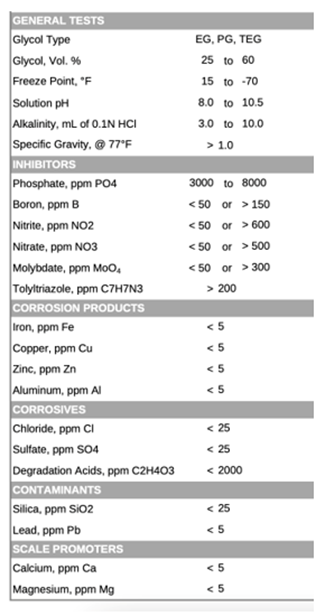
c. Approved Manufacturers:
i. Dow Chemical Dowfrost
ii. G2 Arctic Snow
iii. Interstate Intercool P-300
15. The make–up water used for pre–blended product shall be distilled, deionized and/or approved low TDS.
a. The glycol/water blend must satisfy the water quality limits listed above, with the exception of pH, which shall be in the range of 8.5–10.5.
16. Material Safety Data sheets shall be provided in O&M Manuals.
17. All closed Recirculating Water Systems, both water and glycol, are to be equipped with a corrosion coupon rack.
a. Rack shall be four station type, manufactured from 3/4” diameter pipe of material suitable for the system service temperatures, with polyethylene mounting panel, inlet and outlet ball shutoff valves, inlet strainer, flow limiter and meter.
b. Install rack in a sidestream configuration across the pump.
c. Acceptable Manufacturers:
i. Advantage Controls
ii. Novatech International
iii. Or approved equal
d. The Water Treatment Vendor shall provide corrosion coupons and analysis.
C. Open Hydronic Systems:
1. Application:
a. Conventional open cooling tower, water–cooled fluid cooler, or evaporative condenser where cooling water is exposed to light, air and metal surfaces, and evaporation of the cooling water concentrates solids.
2. Open Recirculating Cooling System – Treatment Chemicals:
a. Acceptable Manufacturers:
i. Rocky Mountain Aquatech
ii. Summit Laboratories, Inc.
iii. HDS – Rocky Mountain Aqua Tech
iv. Or approved equal
b. The specified Corrosion and Deposit Inhibitor:
i. PERFORMAX MILLENIUM SERIES Drew 2215 Cooling Water Treatment
ii. HDS – RMA–9585: Organo–Phosphonate + Dispersants
c. Microbiological Control options:
i. Option #1: Dual Non–Oxidizing Microbicides
a) BIOSPERSE® 250 Microbicide
b) BIOSPERSE® 3204 Microbicide
c) HDS – RMA–4215: Isothiazolin
d) HDS – RMA–4615: Gluteraldehyde
ii. Option #2: Bromine based Oxidizing Microbicide
a) BIOSPERSE® 261T Microbicide
b) HDS – RMA–4909: Stabilized Liquid Bromine
d. The specified initial system cleaning chemical:
i. FLUSHOUT™ 624L System Cleaner
ii. HDS – RMA–6100: Alkaline System Cleaner
e. The specified wet or dry system corrosion inhibitor for layup:
i. PROTECSOL® 700P Multi–Metal Powdered Corrosion Inhibitor
ii. HDS – RMA–Chemfilm Wet Lay–up Passivator
3. Open Recirculating Cooling System – Equipment:
a. Each system shall include a microprocessor–based controller to automate inhibitor feed, microbicide feed, and tower bleed.
b. Acceptable Vendors/Manufacturers:
i. Summit Laboratories, Inc.
ii. Walchem Corporation
iii. Pulsafeeder, Inc.
iv. HDS – Rocky Mountain Aqua Tech
v. Or approved equal
c. HDS – Vendors/Manufacturers not Allowed:
i. Solenis, Industrial Water Division
ii. Walchem Corporation
iii. Pulsafeeder, Inc.
d. The controller shall have the following minimum capabilities and features:
i. Be able to measure system–water conductivity and energize a solenoid actuated bleed valve to control Cycles of Concentration.
ii. Feed Corrosion and Deposit inhibitor via an independent selectable timer with the following options: Feed after bleed has finished, as a percentage of bleed time, feed as a percentage of time elapsed, or feed proportional to makeup water meter.
iii. Feed dual biocides on a 28 day program with independent timers.
a) Timers must include lockout and pre–bleed features.
iv. Include a flow assembly with threaded fittings, adapters, and a built–in sample port.
v. If specified for the system, be able to measure system–water Oxidation–Reduction Potential (ORP) and control oxidant feed based on the ORP value.
vi. Accept input from a Contacting–Head makeup water meter.
vii. If specified, ship the unit and flow assembly pre–mounted for ease of installation.
e. Chemical feed pumps are to be rated at 1.0 gph and to be compatible with the liquid treatment chemicals specified in part A1A and A2A.
f. Chemical Feed Pump Acceptable Vendors/Manufacturers are:
i. Summit Laboratories, Inc.
ii. LMI – Liquid Metronics Division, Milton Roy
iii. Neptune Chemical Pump Company, Inc.
iv. Walchem
v. Pulsafeeder
vi. Prominent
vii. Or approved equal
g. The pumps shall have the following minimum capabilities and features:
i. Ship with suction and discharge tubing, a suction line foot valve, and a threaded injection check valve.
ii. Pump design must include: Priming line pressure release, back pressure function, anti–syphon function, and discharge line depressurization function.
iii. Pump must have totally encapsulated electronics to protect against damage from moisture and corrosive conditions.
iv. Pumps shall be electronically pulsed, positive displacement diaphragm–type metering pumps.
h. Contacting–head water meters shall be installed in the on cooling tower make–up line.
i. The electrical signal generated by water meter output shall be connected to the microprocessor–based controller.
i. Contacting–Head Water Meter Acceptable Vendors/Manufacturers:
i. Summit Laboratories, Inc.
ii. Master Meter, Inc.
iii. HDS – Badger
iv. HDS – Neptune
v. Or approved equal
j. HDS – Contacting–Head Water Meter Vendors/Manufacturers not Allowed:
i. Summit Laboratories, Inc.
k. Meter sizes shall be based on chiller tonnage. Recommended sizes:
i. Up to 400 tons:
a) 3/4″ with 10–gallon contact
ii. 401 tons to 800 tons:
a) 1″ with 100–gallon contact
iii. 801 tons to 1,600:
a) 1 1/2″ with 100–gallon contact
iv. 1,601 tons to 3,000 tons:
a) 2″ with 100–gallon contact
v. 3,001 tons to 5,000 tons:
a) 3″ turbine with 1,000–gallon contact
l. A general purpose, normally closed solenoid valve shall be energized by the microprocessor–based cooling tower controller as needed to regulate tower bleed.
m. Acceptable Vendors/Manufacturers:
i. Summit Laboratories, Inc.
ii. ASCO
iii. Or approved equal
n. Solenoid valve sizes shall be based on chiller tonnage. Recommended sizes:
i. Up to 500 tons –
a) 1/2”
ii. 501 tons to 1,000 tons –
a) 1/4″
iii. 1,001 tons to 2,000 tons –
a) 1″
iv. 2,001 tons to 4,000 tons –
a) 1 1/2″
o. All open reciculating water systems shall be provided with a corrosion coupon rack.
i. Rack shall be four station type, manufactured from 3/4” diameter pipe of material suitable for the system service temperatures, with polyethylene mounting panel, inlet and outlet ball shutoff valves, inlet strainer, flow limiter and meter.
ii. Install rack in a sidestream configuration across the pump.
iii. HDS – A four–station, ¾” PCV corrosion coupon rack should be installed in a convenient side stream.
p. Coupon Rack Acceptable Manufacturers:
i. Advantage Controls
ii. Summit Laboratories, Inc.
iii. HDS – Rocky Mountain Aqua Tech
iv. Or approved equal
q. HDS – Coupon Rack Manufacturers not Allowed:
i. Advantage Controls
ii. Solenis, Industrial Water Division
r. The Water Treatment Vendor shall provide corrosion coupons and analysis.
4. Filtration:
a. Mechanical solids–separators are not useful in open Recirculating Cooling Tower Systems.
i. These are designed to remove heavy sand–type particles, not the light contaminants scrubbed into cooling tower water.
ii. These Systems have been installed in the past and have failed to provide any benefit.
iii. The central plant installation has been removed and replaced with a sand filter.
iv. Mechanical solids–separators shall not be specified, purchased, or installed.
b. Sand filters are the most widely used Mechanical Filtration Systems for open Recirculating Cooling Systems.
i. They are compact, can be fully automated, and are capable of removing solids as small as 5 microns in size.
ii. By installing a sand filter in a side–stream with 3%–10% recirculating flow, filtration is cost–effective and practical.
iii. Since side–stream filters are designed to automatically backwash, operator involvement in changing pleated filters is minimized.
iv. A side–stream sand filter shall be your first choice for Open Recirculating Systems.
c. For smaller Systems, where space or budgetary considerations preclude the use of a sand–filter, use of pleated bag filters in a side stream is useful.
i. Strainrite models have been used with success at the University.
d. Filtration Acceptable Vendors/Manufacturers:
i. Summit Laboratories, Inc.
ii. Webster Associates for Strainrite pleated filters
iii. Webster Associates for Vortisand by Sonitec Side Steam filtration sand system
iv. Or approved equal
e. HDS – Filtration Vendors/Manufacturers not Allowed:
i. Solenis Industrial Water Division
f. Filtration Systems shall be specified for new construction and major upgrades.
i. The specific type/size of filter is dependent on the particulars of the job.
D. Treatment for Steam Boiler Feedwater:
1. Steam Boilers – Treatment Chemicals
a. Acceptable Vendors/Manufacturer:
i. Summit Laboratories, Inc.
b. Specified Internal Boiler Water Deposit Inhibitor:
i. AdVANtage Plus® 6445 Boiler Water Treatment
ii. AdVANtage Plus® 1400 Boiler Water Treatment
c. Specified Oxygen Scavenger:
i. CATALYZED SULFITE Corrosion Inhibitor
d. Steam and Condensate Line Treatment:
i. AMERCOR® 8850 Corrosion Inhibitor
e. One–Drum Treatment options for Systems with softened water:
i. DREWTROL® 7000 Boiler Water Treatment – For Systems where neutralizing amines are acceptable.
ii. DREWTROL® 7027 Boiler Water Treatment – For Systems where neutralizing amines are not acceptable.
2. Steam Boilers – Treatment Equipment Specifications
a. Each system shall include a microprocessor–based controller to automate chemical feed, continuous blowdown.
b. Acceptable Vendors/Manufacturers:
i. Summit Laboratories, Inc.
ii. Walchem Corporation
iii. Pulsafeeder, Inc.
iv. Or approved equal
c. The controller shall have the following minimum capabilities and features:
i. Be able to intermittently measure boiler–water conductivity and energize a bleed valve to control Cycles of Concentration.
ii. Feed chemical via an independent selectable timer with the following options:
a) Feed after bleed has finished, with or without feed lockout timer
b) Feed after bleed has finished, as a percentage of bleed time
c) Feed as a percentage of time elapsed
d) Feed proportional to make–up water
e) Include a flow assembly and orifices (or a throttle valve) appropriate for the boiler pressure.
iii. Accept input from a Contacting–Head makeup water meter.
d. Each system shall be supplied with a softener for pretreatment of makeup water.
e. Acceptable Vendors/Manufacturers:
i. Summit Laboratories, Inc.
ii. Stonehand Industries
iii. Or approved equal
f. Softeners must be specified to meet the demands of each individual project. Suggested requirements are:
i. System shall automatically regenerate itself based on throughput.
ii. System shall include sample valves for verifying the performance of the unit.
iii. Wherever possible, the system shall include two resin beds so that one can be in service when the other is regenerating.
g. Pumps for chemical feed are to be compatible with the treatment chemicals specified.
i. Acceptable Vendors/Manufacturers:
a) Summit Laboratories, Inc.
b) LMI – Liquid Metronics Division, Milton Roy
c) Neptune Chemical Pump Company, Inc.
d) Walchem
e) Pulsafeeder
f) Prominent
g) Or approved equal.
ii. The pumps shall have the following minimum capabilities and features:
a) Ship with suction and discharge tubing, a suction line foot valve, and a threaded injection check valve.
b) Pump design must be appropriate for the pressure of the system into which it is pumping chemical.
c) Pump design must be resistant to damage from moisture and corrosive conditions.
h. Contacting–head water meters shall be installed in the on make–up line.
i. The electrical signal generated by water meter output shall be connected to the microprocessor–based controller.
a) Acceptable Vendors/Manufacturers:
i. Summit Laboratories, Inc.
ii. Master Meter, Inc.
iii. Or approved equal
b) Meter sizes shall be based on expected system makeup requirements.
i. A valve package, appropriate to the system pressure, and designed to be operated by the microprocessor–based controller shall be supplied to regulate continuous blowdown.
i. Acceptable Vendors/Manufacturers:
a) Summit Laboratories, Inc.
b) Pulsafeeder
c) Worcester
d) Or approved equal.
j. Valves sizes shall be specified based on boiler water pressure/temperature and expected load.
i. Motorized ball valves may be required for pressures greater than 100 psig.
ii. Refer to particular system application requirements.
k. Include an orifice union and plates (or a throttle valve) appropriate for the boiler pressure.
i. Orifice unions or throttle valves control the continuous blowdown flow rate and prevent flashing at the conductivity sensor.
23 30 00 – HVAC AIR DISTRIBUTION
A. Zoning:
1. Rooms in HVAC zones shall be of similar use, loading, and façade exposure.
a. For the purpose of zoning, similar use is defined as variation of the design internal load of 50% or less for more than one hour (continuous).
b. Zones shall be limited to three rooms.
c. HDS – Resident hall rooms and apartments will be independently controlled.
d. A room at a corner or with façade exposure different than surrounding rooms shall have its own zone.
2. Refer to Section 23 09 00 – INSTRUMENTATION AND CONTROL FOR HVAC for more information.
B. All restrooms shall have supply air, regardless of size, at 80% of the exhaust air quantity.
1. If heat loss calculations require more supply, exhaust shall then be increased to 120% of supply air.
C. All break rooms shall be equipped with an exhaust system.
1. HDS – All break rooms shall be exhausted at a minimum rate of 1 cfm per square foot.
D. Consider energy saving means of turning off or lowering exhaust when not in use.
23 31 00 – HVAC DUCTS AND CASINGS
A. Metal Ducts:
1. All air distribution work in occupied and unoccupied buildings shall be protected from contamination in conformance with SMACNA Indoor Air Quality Guidelines for Occupied Buildings Under Construction.
2. Work that has not been adequately protected shall be disassembled, cleaned and reinstalled at the Contractor’s expense, including all costs related to delay, out–of–sequence work and general conditions.
3. Sheet metal work shall be installed following SMACNA standards.
4. Ductwork and housings shall be so constructed as to be airtight and watertight.
a. The Specifications shall be written to reserve the right to reject any work that is not ‘airtight’ in the sense of the current standards of the industry.
5. Ducts shall not be sealed with pressure sensitive tape such as “duct tape”.
a. Hard cast or other sealants shall be used.
6. Rooftop ductwork shall be spiral wound.
a. Square duct is allowed only upon approval through the Project Representative.
7. HDS – Prefabricated engineered ductwork is acceptable as an alternative to welded duct.
8. HDS – Hard 90-degree fittings are prohibited.
B. Non–Metal Ducts:
1. Fiberglass ductwork is not permitted.
23 33 00 – AIR DUCT ACCESSORIES
A. Dampers:
1. Dampers shall be installed in Duct Systems to permit balancing of air quantities.
2. Main duct runs must have dampers to permit proper division of air quantities in the Duct Systems.
a. Each supply outlet and each exhaust branch must have a damper control.
3. Dampers that are integral parts of supply or exhaust diffusers or grilles are permitted but must be approved during the design phase.
4. Fire dampers shall be installed where required for ducts which pass through rated firewalls or ceilings.
a. Ducts shall be fitted with fire dampers and frames such that its fire resistance shall be equal to that of the wall or ceiling in which it is located.
b. Dampers shall be sized to provide full duct size opening through wall, partition, or ceiling.
5. Where fire dampers are installed, paint duct red at damper, provide tight fitting access doors sealed with gaskets for inspection and replacement of fusible links.
a. Doors shall be installed on side of fusible link.
b. Where these doors occur on concealed ducts, provide access doors in walls or ceiling properly aligned to permit the servicing of the fusible links.
c. Mark ceiling or walls according to accepted identification.
B. Silencers (Attenuators):
1. Acceptable Products:
a. Kinetics Noise Control
b. Vibro–Acoustics
c. IAC Acoustics
d. Semco
e. Or approved equal
2. Products not Allowed:
a. None listed
3. Discussion:
a. Sound attenuators shall be located in accessible locations with room for future removal and replacement.
b. Duct access doors shall be installed upstream and downstream to permit inspection.
c. Attenuators shall be accessible for future replacement.
C. Turning Vanes:
1. Specify type with low pressure loss and low noise transmission.
D. Access Doors:
1. Minimum 12”x12” size.
E. Flexible Connectors:
1. Materials of construction shall be compatible with chemicals in airstream.
F. Flexible Ducts:
1. Flexible duct shall be limited to a maximum of 8’–0” and shall be installed and supported with no single bend greater than 60 degrees and total bends not to exceed 180 degrees.
2. Air diffusers, registers and grilles which will have flexible duct connections shall have a rigid sheet metal elbow installed at diffuser.
G. Duct Liners:
1. Acceptable Products:
a. Armacell
b. K–Flex Duct Liner Gray
c. Or approved equal
2. Products not Allowed:
a. Duct liners must be non–friable closed cell elastomeric foam.
b. Fiberglass duct liner is prohibited.
3. Discussion:
a. Duct liner is prohibited on supply and return ductwork unless approved by the Project Representative.
i. External insulation and dedicated sound attenuators shall be installed to provide thermal and acoustic control.
b. Duct liner may be approved in cases where attenuators are not practical such as the discharge of small packaged units.
i. For these applications, sections of lined air ducts will be permitted, but the length shall be limited and the ducts shall be arranged to permit future replacement.
c. Duct liner shall be closed–cell, elastomeric, mold resistant, plenum–rated, erosion resistant, smooth surface, non–dusting, cleanable, self–adhering, meeting NFPA 90A and 90B.
d. Fiber liner is allowed in discrete items that can be reasonably removed and replaced, such as sound attenuators, return air boots into plenums, and fan–coil units.
i. Fiber liner is absolutely prohibited in supply ductwork.
23 34 00 – HVAC FANS
A. Axial HVAC Fans:
1. Axial fans are not desirable.
2. When necessary, axial fans shall be belt driven and have removable access doors.
B. Centrifugal HVAC Fans:
1. Acceptable Products:
a. For fan wheels larger than 12”:
i. Greenheck
ii. New York Blower
iii. Peerless
iv. Twin City
v. Cook
vi. Or approved equal
2. Products not Allowed:
a. None listed
3. Discussion:
a. Directly driven fans are preferred to reduce maintenance.
b. Maximum size for motors in a fan array application shall be 20 horsepower.
c. Minimum size for motors in a fan array shall be 5 horsepower.
d. Minimum number of fans in a fan array shall be 6, unless fan motors at this quantity drop below the minimum horsepower.
i. In that case, the maximum number of even–number fans shall be provided.
e. All fans in fan arrays shall be rigidly mounted. Vibration isolators in fan arrays are prohibited.
f. V–belt drives shall be rated at not less than 200% of motor nameplate rating.
i. Belt speeds shall not exceed 4500 feet per minute.
g. Center distances between driver and driven sheaves shall meet the Manufacturer’s minimum and maximum.
h. All sheaves shall be fixed pitch type.
i. All belt–driven fans shall have belt and pulley guards.
j. Fans shall be provided with accessibility for balancing and cleaning.
i. Fans with inlet and outlet duct connections shall have housing access doors regardless of size.
k. Building air handling unit fans shall be provided with external bearings only.
i. Shafts 3/4” and larger shall have spherical roller bearings.
ii. No internal bearings recessed into fan housing shall be allowed.
iii. All bearings shall be accessible for lubrication and maintenance.
l. All fans shall have stamped metal data/nameplates fastened to housing with screws or rivets.
i. Plastic plates are not acceptable.
m. All connections between fans and ductwork shall be with flexible connectors.
n. Fan roof curb and housekeeping foundations are shown in the CSU Facilities Planning, Design and Construction Standards – Additional Documents.
o. Aluminum wheels are not allowed except for spark proof applications.
p. HDS – Continuous duty fans shall utilize pillow block bearings.
23 35 00 – SPECIAL EXHAUST SYSTEMS
A. General:
1. Exhaust Systems which may transport offensive odors, noxious gases, etc., are to be separate Systems.
2. Provide identifying labels on exterior stacks per CSU EHS instructions through the Project Representative.
3. Fans shall be located so that negative pressure exists in all exhaust ducts within the System.
4. Install weatherproof housing over motor and drive when exposed to weather.
5. Metal interior casings and wheels shall be coated if fumes are corrosive.
6. Outside air supply shall compensate for air exhausted by fume hoods, kitchen hoods, or other special exhaust equipment.
B. Fume Hood Exhaust Systems:
1. Fume hood design shall comply with the American National Standard for Laboratory Ventilation ANSI/AIHA No. Z9.5– latest edition.
2. Acceptable types of fume hoods (auxiliary, bypass etc.) are identified in Division 11 – Equipment.
3. Exhaust fans shall have standard arrangements.
a. Refer to CSU Facilities Planning, Design and Construction Standards – Additional Documents for Fume Hood Exhaust Fan for fan and stack arrangement.
b. Coatings or alternate materials shall be specified as necessary.
4. Where hoods are installed, care must be taken to ensure an adequate supply of tempered air whenever the hood exhaust fans are operating.
5. It is desirable in lab buildings to make allowances in the HVAC and Exhaust Systems for the future addition of fume hoods.
6. The face velocity is determined by CSU EHS through the Project Representative.
a. This face velocity is to be specified in the Design Documents, and the balancer shall balance the system to this value.
b. The actual total exhaust rate that the fan pulls will be more than the face area exhaust rate.
c. Refer to Division 11 – Equipment for additional information.
7. Exhaust duct materials may be galvanized duct, PVC duct or stainless–steel type 304 or 316.
a. Each application must be evaluated to determine which material is appropriate.
b. PVC Duct Systems shall have glue used in joints checked for compatibility.
c. When welded joints are required, duct thickness shall be 16 gauge or less.
8. Exhaust ducts shall have a minimum velocity of 1200 fpm.
a. Discharge stacks shall terminate a minimum of 10’–0” above the roof with a minimum terminal velocity of 2000 fpm.
9. Manifold Exhaust Systems are encouraged where compatibility of fumes is not a problem and where construction cost savings would be realized.
a. Manifolding shall occur before fan and multiple fans with separate discharge stacks and shall be sized for redundancy in capacity, such as two fans sized for 100% load with frequency drives or inlet vanes to control fans at necessary flow requirements.
C. Laboratory Air Control Systems:
1. A Laboratory Airflow Control System (LACS) shall be furnished and installed under this section.
2. The LACS shall be capable of operating under the building BAS (Alerton or JCI) and be fully integrated to it.
a. Each laboratory shall have a dedicated LACS
b. Each dedicated LACS shall support a minimum number of network–controlled airflow devices as the space requires plus 20% as per BAS controls standard.
c. The LACS shall not rely on network communication for room airflow and pressurization control such that a loss of BAS communication does not affect the room airflow control or result in a loss of room pressure.
3. Refer to Section 23 09 00 – INSTRUMENTATION AND CONTROL FOR HVAC for more information.
4. The LACS shall support BACnet communication protocol for integration into the BAS.
a. The list of LACS points to be integrated shall be approved by CSU BAS.
b. Point naming shall follow correct point naming scheme.
i. Contact CSU BAS for correct naming scheme.
c. Coordinate with CSU BAS for desired Alarm Points.
d. No intrinsic alarming is allowed, programming and setup for the device shall be configured for this not to occur.
5. The LACS shall provide at least a five year standard warranty.
6. Protocol conversion gateway devices for interfacing with a BACnet building level network are prohibited.
a. No additional applications/front ends or machines shall be needed to interface with the LACS.
7. The airflow control device shall be pressure independent over its specified differential static pressure operating range and shall respond to maintain specific airflow within one second of a change in duct static pressure irrespective of the magnitude of pressure and/or flow change or quantity of airflow controllers on a manifold system.
8. The control variable for the exhaust flow rate of a laboratory fume hood shall be the face velocity of the fume hood.
9. The laboratory control system shall vary the amount of make–up/supply air into the room to operate the laboratories at the lowest possible airflow rates necessary to maintain temperature control, achieve minimum ventilation rates, and maintain laboratory pressurization in relation to adjacent spaces.
10. If the total exhaust flow becomes insufficient, the LACS shall prioritize the fume hood exhaust over the general exhaust.
11. The airflow control device shall maintain accuracy within +/– 5% of signal over an airflow turndown range of no less than:
a. 8 to 1 (all valves)
b. 5 to 1 (low pressure shut off valves only)
12. No minimum entrance or exit duct length shall be required to ensure accuracy and/or pressure independence.
13. No orientation requirements shall be required to ensure accuracy and/or pressure independence.
14. The room level airflow control devices shall not rely on external or building–level control devices to perform room–level control functions.
a. Each LACS shall be able to operate standalone if communication is lost to the network.
15. Each LACS shall have the capability of performing fume hood control, pressurization control, temperature control, humidity control, and implement occupancy and emergency control schemes.
16. Sensors:
a. Each fume hood shall be provided with a dedicated fume hood controller, sash sensor, velocity sensor (sidewall sensor) and monitor.
b. The sash sensor shall measure the height of each vertical moving fume hood sash and a sidewall velocity sensor shall measure the hoods face velocity.
i. Upon movement of the fume hood, the sash sensor will measure the fume hood’s total open area to determine the required fume hood exhaust air flow required to maintain the average face velocity set point.
ii. Once this target is achieved the fume hood controller will adjust the exhaust volume until the hood’s measured face velocity matches the average face velocity set point.
c. The dedicated fume hood monitor shall be mounted to the face of the fume hood.
i. The fume hood monitor shall include an LCD screen capable of displaying the fume hood parameters including velocity, alarm status, alarm reason, valve airflow, valve differential pressure or alarm, and all hood configuration variables.
d. The fume hood controller shall be fully configurable in the field from the fume hood monitor without having to access hardware in the ceiling.
17. Room Pressure Sensor:
a. Provide room pressure sensors at all entry doors to laboratories or where shown on plans.
b. Room pressure shall be monitored at all times with reference to the adjacent space.
c. The room pressure reading shall be available to the BMS.
18. Room Level Controller:
a. A BACnet ms/tp compatible controller shall be field mounted per room.
b. The controller shall be fully configurable from a local lap–top computer and through the main BAS for the building.
c. Display of current readings and all flows, outputs, tuning values, set points and status values shall be available through this interface and through the main BAS for the building.
d. Entry of control set points and scaling/tuning shall also be provided by this interface and through the main BAS for the building.
e. Intrinsic alarming is not allowed from the LACS device.
i. All alarming shall be configured though the main BAS for the building.
19. LACS Vendor shall provide a red lined/updated detailed control drawing package to include a communication and power riser, sequence of operations, and points list.
20. Room temperature sensor shall have a digital display of room temperature and setpoint.
D. Perchloric Exhaust Systems:
1. Perchloric hoods can only be used for perchloric work and cannot be used for other types of service, especially organics.
2. Stainless steel fume hoods designed for perchloric work shall be provided.
3. Separate exhaust fan. Perchloric hoods cannot be combined with other hoods.
4. Fans shall be made of fiberglass reinforced plastic (FRP) with vinyl ester resin such as Derakane 510A40 by Dow Chemical or equal.
a. A surface veil shall be provided if available in fan size.
5. Provide FRP BI wheel dynamically balanced with metal hub and pillow block bearings.
a. Shaft and fasteners encapsulated with FRP with viton shaft seal.
b. Flanged inlet and outlet connectors with neoprene gaskets, 1” threaded housing drain, bolted inspection port.
c. Steel welded base, enamel coating on exterior metal with weatherproof cover/belt guard suitable for exterior use.
6. Stainless steel type 316 welded ductwork or PVC ductwork shall be provided as described below.
7. PVC (unplasticized) ductwork with plastic welded, flanged connections with neoprene gaskets. Glued fittings are not permitted.
8. Ductwork shall not have sharp corners or edges where perchloric crystals could accumulate. Slope ductwork to drain.
a. Discharge stack from fan shall be continuous and terminate 7’–0” above roof.
9. Wash down system with type 316 stainless steel or PVC nozzles with pipe unions at duct penetration every 6’–0”, at elbows and fans.
a. Wash down nozzles shall also be installed inside hoods. Include drainage piping.
b. Provide heat tape and insulation on exterior piping.
c. Provide multiple valve arrangement for draining of wash pipe for freeze protection with control at hood.
d. Provide written procedure for use of wash down system to be laminated and installed at hood.
23 36 00 – AIR TERMINAL UNITS
A. General:
1. Units shall be pressure independent.
2. Box insulation must be protected from airstream erosion or a non–friable type.
B. Units with Reheat Coils:
1. Electric reheat is prohibited.
2. All new and retrofit hydronic coils shall be sized for maximum 140 °F heating supply water temperature.
a. Coil fins shall be spaced at maximum 10 per inch.
3. Provide hinged and tool–less access on upstream side of coil for inspection and cleaning.
4. Provide a temperature sensor downstream of the reheat coil.
23 37 00 – AIR OUTLETS AND INLETS
A. Outside Air Inlets:
1. Ground level intakes are not desirable.
2. Outside air louvers, intake sections, and RTUs shall be selected to prevent snow and moisture entrainment.
a. Make provisions for low face velocity in intakes, low velocity in duct/plenums downstream of intake, drains to channel snow and moisture away from downstream duct and equipment.
3. Design shall accommodate required airflow without excessive noise or pressure drop.
4. Provide bird screening on exterior side to prevent entry of birds or debris.
a. Screens shall have minimum 1/2” openings and shall be accessible for routine maintenance.
B. Room Diffusers, Registers, and Grilles:
1. All supply diffusers and exhaust/return grilles shall conform with noise criteria specific to room application per ASHRAE.
2. All exhaust and return grilles located in rooms anticipated to have high levels of dust such as animal holding, dry labs, and art & maker spaces, shall have minimum 1/2” openings.
C. Gravity Ventilators:
1. (future)
23 38 00 – VENTILATION HOODS
A. Commercial Kitchen Hoods:
1. Shall be VAV
2. HDS – Refer to Division 11 – Equipment
B. Fume Hoods (not lab):
23 41 00 – PARTICULATE AIR FILTRATION
A. Panel and Bag Filters:
1. Acceptable Products:
a. Panel Filters:
i. Filtration Concepts
ii. Camfill/Farr
iii. AAF
iv. Koch
v. Or approved equal
b. Bag and Final Filters:
i. Filtration Concepts
ii. Camfill/Farr
iii. Columbus Industries (for bags)
iv. Koch
v. Or approved equal
2. Discussion:
a. No fiber mesh filters allowed. Filters must be minimum pleated type.
b. All air supplied to the building shall be filtered.
c. Main building Ventilation Systems shall filter the air at central filter banks.
d. Central filter banks shall have pre–filters of 25% medium efficiency (MERV 8) pleated type with a standard size of 24” x 24” x 2”.
e. Final filters shall be 85% bag or 85% rigid filters (MERV 13) with a standard size of 24” x 24”.
i. The depth shall be dependent upon pressure drop and space requirements.
f. For Systems serving primarily office and classroom space, a single set of filters shall be installed, 4” MERV 9 with a standard size of 24” x 24”.
i. HDS – For systems servicing primarily office and classroom space, only a single set of filters shall be installed, 2” MERV 8 with a standard size of 24” x 24” inches.
g. Bag filters shall be accessible for either upstream or downstream servicing.
i. Pleated panel filters shall be removable from the upstream side without disturbing the bag filters.
h. Systems shall not be operated during construction without the pre–filters in place.
i. New pre–filters and bag filters shall be furnished as part of the contract at time of substantial completion.
i. Exhaust Air Systems that have filters for protection of heat recovery coils shall be 2” pleated filters of 25% efficiency (MERV 8).
i. Filters shall be removable through side access frames with attention paid to protruding screws which would prevent proper installation & removal.
j. Avoid the use of charcoal filtration.
B. High Efficiency Filtration:
1. Portable high efficiency particulate air (HEPA) filtration units are preferred over permanent installations.
2. If HEPA filters are required as part of a permanent installation, provide engineered filtration units which contain booster fans and means of overcoming large pressure drops of these filters.
23 51 00 – BREECHINGS, CHIMNEYS, AND STACKS
A. Draft Control Devices:
1. Not allowed
B. Fabricated Stacks:
1. Not allowed
C. Gas Vents:
1. Only Listed and Manufacturer approved stainless steel vents shall be installed for condensing boilers.
2. Listed and Manufacturer approved Type–B vent shall be installed for natural gas atmospheric and power burner equipment.
3. HDS – Listed and manufacturer approved stainless steel or approved non–metallic vents shall be installed for condensing boilers.
D. Systems not Allowed:
1. Polypropylene gas vent systems
23 52 00 – HEATING BOILERS
A. Electric Boilers:
1. Not allowed
B. Condensing Hot Water Boilers:
1. Acceptable Products:
a. Raypac Rheem Company Commercial Products – Xtherm
b. Lochinvar – Crest or Knight XL
c. Patterson Kelly – Solis
d. Riello “Array” or Array SE
e. HDS – AERCO Benchmark Series
f. Or approved equal
2. Products not Allowed:
a. AERCO Benchmark Series
b. Fulton
3. HDS – Products not Allowed:
a. Raypac Rheem Company Commercial Products – Xtherm
b. Patterson Kelly – Solis
c. Riello “Array” or Array SE
4. Discussion:
a. Burner operation shall be modulating with minimum 5:1 turndown ratio.
b. At minimum, condensing boilers shall have the following controls and trim:
i. Operating control, hi–limit cutout, safety low water cut–off, electronic supervised spark ignition, ASME pressure relief valve set for proper psi for defined operating conditions, temperature and pressure gages, built in air elimination, control panel with indicating lights, ASME CSD–1 compliance, and Boiler management system.
ii. Refer to Section 23 09 00 – INSTRUMENTATION AND CONTROL FOR HVAC for more information.
c. Boiler shall be approved for sidewall direct vent sealed combustion, vertical direct vent sealed combustion, vertical direct vent sidewall air inlet and conventional venting.
i. Venting shall be classified Category I, negative draft, non–condensing, to use type “B” double wall venting materials. Direct vent installations require the use of AL29–4C vent materials.
d. The boiler shall have independent laboratory rating for Oxides of Nitrogen (NOx) of less than 30 ppm corrected to 3% O2.
C. Non–Condensing Tubeless Boilers:
1. General Information:
a. Non–condensing boilers are allowed for steam applications only.
b. Condensing boilers are required for all heating water applications.
2. Vertical Tubeless Type:
a. Acceptable Products:
i. Hurst – 4VT Series Cyclone for steam
ii. Lattner
iii. Or approved equal
D. Non–Condensing Fire–Tube Boilers:
1. Acceptable Products:
a. Hurst Boiler & Welding CO. – Scotch Marine Series 400, 500, with water side economizers for steam and hot water
b. Cleaver Brooks – Scotch Marine Series CBEX Elite, CBEX Premium, 4WG with water side economizers for steam and hot water
c. Superior Boiler Works – Scotch Marine Series Seminole, Mohican, Super Seminole with water side economizer for steam and hot water
d. Hurst Boiler & Welding CO. – LPW Series, hot water
e. Hurst Boiler & Welding CO. – LPE Series, steam
f. Or approved equal
E. Boiler Blowdown Systems:
1. Acceptable Products:
a. Surface blow valve:
i. Provide a stainless full–port ball valve with 110V NEMA 4 actuator having manual override.
ii. Manufacturers:
a) Inline Industries A304F–566–CTT–M10
b) Crane
c) Or approved equal
b. Bottom blow valve:
i. Yarway
ii. Everlasting
iii. Edwards
iv. Or approved equal
F. BAS Integration with Boiler Controls:
1. Refer to Section 23 09 00 – INSTRUMENTATION AND CONTROL FOR HVAC for more information.
23 53 00 – HEATING BOILER FEEDWATER EQUIPMENT
A. Boiler Feedwater Pumps:
1. Acceptable Products:
a. Grundfos
b. Armstrong
c. Bell & Gossett
d. Worthington
e. Or approved equal
2. Products not Allowed:
a. Shipco
3. Discussion:
a. Boiler feedwater pumps shall have seals rated for over 225 °F.
B. Deaerators:
1. Acceptable Products:
a. Grundfos
b. Armstrong
c. Bell & Gossett
d. Worthington
e. Or approved equal
2. Products not Allowed:
a. Shipco
3. Discussion:
a. Deaerator make–up water valves shall have stainless steel seats.
23 57 00 – HEAT EXCHANGERS FOR HVAC
A. Steam to Hydronic Heat Exchangers:
1. Acceptable Products:
a. Amtrol, Inc.
b. Armstrong Fluid Technology
c. Bell & Gossett
d. Taco, Inc.
e. Or approved equal
2. Products not Allowed:
a. Thermaflo
3. Discussion:
a. For information on District Energy steam system design parameters, refer to Division 33 – Utilities, 33 63 00 – STEAM ENERGY DISTRIBUTION.
b. The accepted products are field built units which include the shell and tube heat exchanger, condensate pump, steam control valve, and all associated piping, traps, fittings, and controls.
4. Two parallel steam control valves shall be provided.
a. Size at approximately 1/3 and 2/3 of maximum steam demand.
5. Steam traps on the skid shall be rated for minimum 75 psig.
6. Heat exchangers shall be ASME constructed and stamped.
7. All heat exchangers shall be located to allow clear floor space for the removal of tube bundles.
8. Steel tube bundles are not allowed.
9. Tubes shall be 3/4” copper.
10. Paralleled steam heat exchangers shall be provided as required to ensure redundancy and future capacity
a. Refer to Section 23 00 00 – GENERAL INFORMATION.
B. Flat Plate Hydronic Heat Exchangers:
1. Acceptable Products:
a. Alfa Laval
b. Bell & Gossett
c. Tranter
d. Mueller
e. Or approved equal
2. Products not Allowed:
a. None listed
3. Discussion:
a. For information on District Energy chilled and heating water system design parameters, refer to Division 33 – Utilities, Section 33 61 00 – HYDRONIC ENERGY DISTRIBUTION.
b. Flat plate heat exchangers shall be used for chilled and heating water service, and process cooling service
i. Do not utilize flat-plates where there is a high potential for plugging such as untreated water applications.
c. Limit approach temperature to 2 °F for chilled water service and 5 °F for heating water.
i. Building–side pressure drop shall be optimized for lowest lifecycle cost and district–side pressure drop shall be 5 psi maximum.
ii. Performance shall be certified in accordance with AHRI 400.
d. Units shall have gaskets rated for the system fluids.
i. Brazed units are allowed for flows less than 50 gpm.
e. Piping and floor space shall be configured to allow for plate removal and cleaning.
f. Provide Clean–In–Place (CIP) valves at all four connections.
i. Refer to CSU Facilities Planning, Design and Construction Standards – Additional Documents.
23 61 00 – REFRIGERANT COMPRESSORS
A. Centrifugal Compressors:
1. Allowed
B. Reciprocating Compressors:
1. Not allowed
C. Scroll Compressors:
1. Allowed
D. Screw Compressors:
1. Allowed
23 64 00 – PACKAGED WATER CHILLERS
A. General Information:
1. Refrigerants:
a. Refer to Section 23 23 00 – REFRIGERANT PIPING.
2. Chiller Piping:
a. All chillers shall have flanged connections.
b. Provide a section of piping for removal at all evaporator and condenser connections, between the chiller connection and the first isolation valve.
c. Configuration shall be such that upon removal, minimum 4’–0” of clear space remains for access to the tube bundles.
d. For systems containing glycol, refer to Section 23 25 00 – HVAC WATER TREATMENT.
3. Electric sub meters shall be provided for all chillers 20 tons cooling capacity and larger.
4. Equipment shall be evaluated against local site noise level goals.
5. Controls:
a. Provide Manufacturer’s standalone controller with hard wired BAS alarm contacts.
b. For integration to building controls, refer to Section 23 09 00 – INSTRUMENTATION AND CONTROL FOR HVAC.
B. Water Cooled Chillers:
1. Centrifugal Compressor Machines:
a. Centrifugal chillers with oil coolers, which are cooled with chilled water, shall have pressure and temperature gauges installed on inlet outlet of chiller out of the influence of the oil cooler circuit.
b. Acceptable Products:
i. Daikin
ii. Trane
iii. York
iv. Or approved equal
c. HDS – Products not allowed:
i. Daikin
2. Scroll Compressor Machines:
a. Acceptable Products:
i. Daikin
ii. Trane
iii. York
iv. Or approved equal
b. HDS – Products not allowed:
i. Daikin
3. Screw Compressor Machines:
a. Acceptable Products:
i. Daikin
ii. Trane
iii. York
iv. Or approved equal
b. HDS – Products not allowed:
i. Daikin
4. Reciprocating Compressor Machines:
a. Not allowed
C. Air Cooled Chillers:
1. Hail guards shall be installed on all condenser coils.
2. Low ambient accessory packages for air–cooled condensers for intermittent winter cooling requirements down to about 40 °F outside air temperature shall be, at a minimum, variable speed condenser fan control based upon the outside air temperature or refrigerant gas temperature/pressure.
a. Thermostatic expansion valves shall be provided with these Systems.
b. Orifice type valves are not permitted.
3. Continuous and critical winter cooling requirements shall be flooded condenser control with liquid receiver and three–way head pressure control valve.
a. As described above, thermostatic expansion valves are required.
4. Provide screening on condenser coils to prevent entry of debris.
a. Screens shall have minimum 1/2” openings.
b. HDS – Shall be serviceable & removeable.
D. Absorption Water Chillers:
1. Not allowed
23 65 00 – COOLING TOWERS
A. General:
1. Application:
a. Induced draft towers are preferred over force draft for lower lifecycle cost.
b. Provide closed–loop fluid coolers having either a dry or sprayed coil in applications requiring process or winter cooling.
2. General Configuration:
a. 1/2” x 1/2” screening shall be utilized where needed to prevent birds from entering a tower.
b. Tower fan motors should be outside of the tower for ease of maintenance.
i. Fan motors in the tower’s airstream are not desirable.
ii. Provide davits for motor maintenance.
c. Access openings shall be provided to all sumps, valves, motors, belts, sheaves, sprayers, and other components. provide access ladders from top to bottom in accordance to OSHA standards.
3. Basins:
a. Indoor sumps shall be considered as an alternative to avoid sump basin heaters during cold weather operation.
b. Where outdoor sump basins are required, provide drains in the bottom of each basin, minimum 2–1/2” diameter located on the opposite side of the suction outlet of the sump piped to sanitary.
i. Piping tower drains to storm water systems is prohibited.
c. For multi-cell towers, external equalization piping is preferred over internal sluice gates for ease of basin maintenance.
d. Basin sweeper jets and sidestream filtration for tower loops is desirable.
4. Makeup Water:
a. Sources in order of preference: industrial water, potable water.
b. Provide means of metering cooling tower makeup and drain for sewer credit purposes.
c. Refer to Division 33 – Utilities for additional information.
B. Induced–Draft Cooling Towers:
1. Acceptable Products:
a. BAC
b. Marley
c. Or approved equal
2. Products not Allowed:
a. None listed
3. Discussion:
a. Towers shall have stainless steel basins and access ladders/walkways allowing inspection and maintenance of both water inlets and fans.
b. Counterflow towers are preferred over crossflow for easier maintenance, lower energy use, and lower noise levels, however crossflow units will be considered where restricted by space.
c. Tower fans shall have VFD’s.
C. Liquid Coolers:
1. Acceptable Products:
a. BAC
b. Marley
c. Or approved equal
2. Products not Allowed:
a. None listed
3. Discussion:
a. For non-glycol units, sprayer and sump shall drain at 40 °F outdoor air temperature.
23 72 00 – AIR–TO–AIR ENERGY RECOVERY EQUIPMENT
A. General Information:
1. This section shall apply to energy recovery equipment associated with air handling systems including Energy Recovery Ventilators (ERVs),
2. Provide upstream filtration for coils. Provide means of monitoring pressure drop across coils and filters.
3. Where applicable, indirect evaporative cooling equipment is allowed with air–to–air recovery equipment. Refer to Section 23 76 00 – EVAPORATIVE AIR–COOLING EQUIPMENT.
4. HVAC controls must comply with requirements listed in the controls section. No packaged controls are allowed.
B. Types Allowed:
1. Heat and energy wheels shall be allowed but shall be heavy–duty institutional quality.
a. Light duty commercial types are not allowed.
2. Heat pipes and thermosiphons are allowed.
3. Metallic fixed plate heat exchangers are preferred over membrane types.
4. Pumped “run–around” air–to–air heat exchangers:
a. Hydronic components as well as airside components must comply with requirements listed under those respective sections.
23 73 00 – INDOOR CENTRAL–STATION AIR–HANDLING UNITS
A. General Information:
1. This section shall apply to air–handling units, both indoor and outdoor, with a total system air volume of greater than 5,000 cfm.
2. Design Intent:
a. Each air handling unit shall be designed for optimal operating efficiency, reliability, and flexibility with the lowest life cycle cost.
3. Unit Life:
a. The air handler casing, structure, finishes, coils, and dampers shall be designed for a minimum 40–year usable life.
4. Face Velocity:
a. Face Velocity shall be maximum 500 feet per minute across coils, filters, dampers, and outside air intake louvers.
b. Provide passive means of preventing snow accumulation inside air handler by providing a baffle behind the louver and reducing velocity to 200 feet per minute before the filter section.
i. Refer to Section 23 37 00 – AIR OUTLETS AND INLETS.
c. Avoid active heating snowmelt systems.
5. To the greatest extent possible, mechanical equipment shall be located indoors to maximize useful service life and for safety and ease of maintenance staff, particularly during adverse weather conditions.
6. Provide recommended minimum service clearances.
a. Units shall be installed to allow removal of all coils, filters, and fans.
7. Units shall include a structural base rail and be placed on a concrete housekeeping pad with sufficient combined height for adequate condensate drain trapping.
8. Air handling units serving computer rooms, museums, and other spaces requiring humidity control shall provide full capacity for design heating, cooling, humidification, and dehumidification within the unit.
9. HVAC supply units with mixed air capability shall have a programmable return air CO2 sensor sequence to regulate the OSA damper.
10. All indoor Air Handing Units shall have dedicated outdoor air, return air, and relief air ducts connected to the unit.
a. Utilizing a mechanical room as an outdoor air, return air, or relief air plenum is prohibited.
11. Air–handling units and their components shall be factory tested according to ARI 430, “Central–Station Air–Handling Units,” and shall be listed and labeled by ARI.
12. Comply with NFPA 90A for design, fabrication, and installation of air–handling units and components.
13. Preferred Manufacturers:
a. Haakon
b. Temtrol – Nortek
c. Governair
d. Energy Labs
e. Engineered Air
f. Innovent
g. HDS – AAON
h. HDS – Annexaire
i. Or approved equal
B. Casing:
1. Thermal Performance:
a. Unit shall be insulated to provide a minimum thermal resistance (R) value of 8 ft²•h•ºF/Btu for indoor units and 12 ft²•h•ºF/Btu for outdoor units throughout the entire unit.
b. Insulation shall completely fill the panel cavities in all directions so that no voids exist and settling of insulation is prevented.
c. Panel insulation shall comply with NFPA 90A.
d. Exposed insulation is not acceptable.
e. Casing shall have additional insulation and vapor seals if required to prevent condensation on the interior and exterior surfaces.
f. Casing shall have a thermal break at each thermal bridge between the exterior and interior.
g. The thermal break shall not compromise the structural integrity of the cabinet.
2. Air Tightness:
a. Maximum air leakage shall be 1% of total air system quantity at 1.5 times design static pressure, up to +/– 8” w.g.
b. Air tightness shall be proven by either a factory or on–site test at the pressure conditions cited above.
c. Specified air leakage shall be accomplished without the use of caulk.
d. Specified air leakage shall include doors, door windows, and door gaskets.
3. Structural:
a. All unit casings shall be double wall, corrosion–resistant, sheet metal panel construction.
b. The removal of side panels shall not affect the structural integrity of the unit.
c. Structural reinforcement shall be designed such that maximum casing deflection is 1/200th of span at 1.5 times the design static pressure, up to +/– 8” w.g.
d. Casing deflection shall be proven by either a factory or on–site test at the pressure conditions cited above.
e. Floors shall be constructed to prevent oil–canning.
f. Floor surfaces shall be non–slip (e.g. checker plate).
i. “Applied” non–slip surfaces (e.g. grit, anti–slip tape) are prohibited.
g. Steel floor plates shall be finished with rust–resistant epoxy paint.
h. Each air handler section shall have a continuous lip with welded corners and seams allowing it to hold 1 1/2” of water without leakage.
i. Provide drains in all sections.
i. Drains shall be trapped.
ii. Traps shall be sized for positive drainage at design pressure conditions.
j. Supply and return openings in floors shall be walkable.
4. Acoustical Performance:
a. Sound transmission loss of the casing assembly shall, in accordance with ASTM E90, equal or exceed the following:
|
Octave Band Center Freq. [Hz] |
125 |
250 |
500 |
1000 |
2000 |
4000 |
|
Transmission Loss [dB] |
21 |
28 |
34 |
44 |
51 |
53 |
b. Acoustical performance shall be proven by either a factory or on–site test.
c. Testing and data shall conform to ARI 260.
5. Access:
a. All components, to include both sides of coils, shall be accessible via doors.
b. Doors shall be reinforced, double–wall insulated panels of same materials and thicknesses as the casing.
c. Doors shall have a stainless–steel piano hinge and two wedge–lever–type latches, operable from inside and outside.
d. Doors shall open against air–pressure differential.
e. Doors shall include a viewing window.
f. Minimum door width shall be 24” or the width needed to remove any fans or equipment from within the compartment, whichever is larger.
i. Minimum door height shall be the full height of the casing, with a maximum height of 72”.
6. Surface Finishes:
a. Outdoor unit finish shall be paint.
i. Paint for outdoor units shall conform to ASTM B117 for 5,000–hour salt spray endurance.
ii. The color of the paint shall be of Project Representative’s choosing.
b. Indoor unit finish shall be corrosion resistant galvanized surface or paint.
i. The color of the paint shall be of Project Representative’s choosing.
7. Electrical:
a. Each section of the unit shall contain a minimum of one marine–grade light fixture per 6’–0” of unit width.
b. Bulbs shall be compact fluorescent or LED.
c. Each section of the unit shall include a dual 120V convenience outlet.
d. A timer switch with indicator light shall be installed outside the opening side of each door.
e. All electrical components, conduit, and wiring shall conform to Division 26 – Electrical.
C. Fans:
1. Fans and fan arrays shall also conform to Section 23 34 00 – HVAC FANS.
2. Carefully evaluate and properly select the most effective fan type and wheel to best suit the needs of the application with emphasis on minimizing operating and life cycle cost, rather than minimizing size and first cost.
3. Fan ratings shall be AMCA certified.
4. Bearings shall be grease–lubricated, self–aligning type, minimum L10 life of 200,000 hours.
5. Fans and motors shall have minimum 4’–0” of access both upstream and downstream for maintenance and replacement.
6. Fans and fan motors weighing greater than 75 pounds shall have provision for rigging and hoisting integral to the unit (e.g. lifting eyes, rails).
a. These provisions shall enable the hoisted equipment to be moved from the installed position to the nearest access door.
7. Units with total air system quantity of 20,000 cfm or greater shall have fan arrays for both supply and return.
8. VFDs serving fan arrays shall conform to Division 26 – Electrical.
9. Fan arrays of eight fans or less shall be served by two VFDs, with one half of the fans driven by each VFD.
a. Fan arrays of greater than eight fans shall be served by three VFDs, with one third of the fans driven by each VFD.
10. Fan arrays driven by electrically commutated motors (ECMs) are acceptable.
a. A panel which emulates a VFD display of array speed shall be provided.
b. The display shall be configurable in that one can change the home screen display to show different data such as the fan speed.
D. Coils:
1. Coils shall be drainable and have manual air relief vents placed at the high point.
2. Preheat coils for 100% Outside Air Systems shall have freeze protection, regardless of indoor or outdoor location of the unit.
a. Refer to Section 23 25 00 – HVAC WATER TREATMENT.
3. For outdoor units, all coils shall have freeze protection.
a. Refer to Section 23 25 00 – HVAC WATER TREATMENT.
4. Steam coils are prohibited.
5. Electric coils are prohibited.
6. Hydronic heating coils should be sized for maximum 140 °F heating water supply temperature.
7. Face and bypass coils are prohibited.
8. Coils shall have minimum 2‘–0” of access both upstream and downstream for cleaning.
9. Coil sizing shall be optimized for life cycle cost by balancing pump energy for the hydronic system with maintaining turbulent flow within the coil at minimum flow.
10. Cooling coils for buildings supplied by the Campus Chilled Water Utility shall be sized to meet the operational performance requirements listed in Division 33 – Utilities, Section 33 61 00 – HYDRONIC ENERGY DISTRIBUTION.
11. Coils shall be ARI 410 tested and certified.
12. Fabricate coil section to allow removal and replacement of each coil segment and to allow in–place access for service and maintenance of coil(s).
a. For units with banks of multiple coil segments, provide independent supports of coils to allow slide out removal and replacement of each coil segment.
b. Coils shall not act as structural component of unit or support other coils.
E. Condensate Drainage:
1. All cooling coil sections and heat recovery coils subject to condensing conditions shall be provided with a stainless–steel drain pan.
2. Drain pans shall be designed in accordance with ASHRAE 62.1, being of sufficient size to collect all condensation produced from all rows of the coil bank.
3. Drain pans shall be sloped in two planes and pitched toward drain connections, promoting positive drainage to eliminate stagnant water conditions.
4. The drain outlet shall be located at the lowest point of the pan and shall be of sufficient diameter to preclude drain pan overflow under any normally expected operating condition.
5. Threaded connections under the unit floor shall not be accepted.
6. Drains shall be trapped external to the unit.
a. Traps shall be sized for positive drainage at design pressure conditions.
7. Units with stacked coils shall have intermediate drain pans to collect condensate from each row of coils.
8. The intermediate drain pans shall be constructed of the same material as the primary drain pan, be sloped to the same requirements, and include drop tubes to guide condensate to the bottom pan.
F. Dampers:
1. Dampers shall be high–performance, low resistance, airfoil type.
2. Dampers shall be low–leakage type with edge seals.
3. Maximum damper leakage shall be 3 cfm per square foot of damper area at 1” w.g.
4. Pivot rod bearings shall be designed such that there are no metal–to–metal or metal–to–bearing riding surfaces.
G. Mixing and Stratification:
1. Units with mixing of air streams shall have a mixing section with necessary components specifically engineered to achieve evenly and thoroughly mixed conditions prior to entering coils.
2. Stratification shall be a maximum 10 °F differential measured at any point across the face of coils, both horizontally and vertically.
3. Mixing performance shall be achieved at all operational airflow conditions (e.g. design heating, design cooling, minimum outdoor airflow, minimum return airflow, design total airflow, minimum total airflow).
4. Mixing performance shall be proven by on–site testing at all operational conditions.
H. Filters:
1. Air–handing unit filtration shall conform with Section 23 41 00 – PARTICULATE AIR FILTRATION.
I. Air Handler Controls:
1. Controls, especially sequences of operation, shall be simple, reliable, and effective.
2. Complicated controls shall not be relied upon to compensate for either inadequate system sizing or configuration.
3. Proprietary (non–BAS) air handler controllers are prohibited.
4. All control wiring for controllers, sensors, dampers, and other devices within the air–handling unit shall be field–installed by the Controls Contractor for the BAS of the building.
5. Air flow measuring stations for visual confirmation or rough flow totalization may be based on pressure probes.
a. Air flow measuring stations used to control the position of dampers or other control outputs shall be thermal dispersion airflow/temperature measure devices capable of producing an accuracy of 2% over a fan operation range of 10 to 1 capacity turndown.
6. Refer to Section 23 09 00 – INSTRUMENTATION AND CONTROL FOR HVAC for more information.
23 74 00 – PACKAGED OUTDOOR HVAC EQUIPMENT
A. Acceptable Manufacturers:
1. Aaon
2. Daikin
3. York
4. HDS – Annexaire
B. Manufacturers not Allowed:
1. Trane
2. Engineered Air
C. Discussion:
1. These units shall have less than 10 tons of cooling.
2. These units typically do not have hydronic coils.
3. Cooling is DX and heating is gas–fired.
4. Cooling shall have digital scroll compressors.
a. Cooling turndown shall be minimum 10:1.
5. Gas fired section shall have modulating gas valves.
a. Heating turndown shall be minimum 5:1.
6. Electric heating is prohibited.
7. Hail guards shall be installed on all condenser coils.
8. Packaged units shall have economizers unless used strictly for make–up air.
9. For units with proprietary controllers, refer to Section 23 09 00 – INSTRUMENTATION AND CONTROL FOR HVAC for more information.
23 76 00 – EVAPORATIVE AIR–COOLING EQUIPMENT
A. Direct–Evaporative Coolers:
1. Not allowed in conjunction with mechanical cooling.
a. In applications where the building design does not require any form of mechanical cooling, direct evaporative cooling may be utilized.
B. Indirect–Evaporative Coolers:
1. Allowed at heat recovery coils in exhaust airstreams
2. Shall be spray type
3. Evaporative media are not allowed.
23 81 00 – DECENTRALIZED UNITARY HVAC EQUIPMENT
A. Packaged Terminal Air–Conditioners:
1. Acceptable Manufacturers:
a. Daikin
b. York
c. Carrier
2. Manufacturers not Allowed:
a. Trane
3. Discussion:
a. To include low ambient operation to 0 °F
B. Computer Room Air Conditioners:
1. Acceptable Manufacturers:
a. Liebert
2. Manufacturers not Allowed:
a. Trane
3. Discussion:
a. Water source condensing units are preferred.
b. For units with air cooled condensing units, include low ambient operation to –20 oF.
C. Air Cooled Split–Systems:
1. Acceptable Manufacturers:
a. Mitsubishi
b. Daikin
c. Carrier
2. Manufacturers not Allowed:
a. None listed
3. Discussion:
a. To include low ambient operation to –20 oF.
b. Fractional horsepower evaporator coil blower motors shall be electrically commutated motors (ECMs).
c. Installation per manufacture requirements shall be followed. Including but not limited to; correct AWG size and distance from indoor unit to outdoor unit for communication is critical.
i. If installation requirements are not followed, the installing party will be required to make the appropriate changes to meet manufacture requirements.
D. Variable Refrigerant Flow Systems:
1. Not allowed
E. Heat Pumps:
1. None listed
23 82 00 – CONVECTION HEATING AND COOLING UNITS
A. Chilled Beams:
1. None listed
B. Fan–Coil Units:
1. Acceptable Manufacturers:
a. Daikin
b. Enviro–Tech
c. International Environmental Corp (IEC)
d. Magic Aire
e. Price
2. Manufacturers not Allowed:
a. None listed
3. Discussion:
a. Vertical or console units are preferred for ease of access and maintenance. If floor area and chases cannot be allocated, ceiling units are acceptable but shall avoid concealed placements above ceilings.
b. Fractional horsepower fan coil blower motors shall be ECMs.
c. Fan coil unit chilled water coils shall be designed to operate at 50 °F entering water.
d. Fan coil unit chilled water operating characteristics shall take the operation of the central plant into consideration.
e. The design operating delta T of fan coil units shall be a minimum of 10 °F, unless approved by FM.
f. Heating coils are to be sized for maximum 140 °F heating water supply temperature.
g. No packaged controls are allowed. Fan–coil unit shall be controlled by building BAS.
C. Unit Ventilators:
1. Not allowed unless units are full return–air.
D. Finned–Tube Radiators:
1. Size heating coils for maximum 140 °F heating water supply temperature.
E. Unit Heaters:
1. Hydronic heating coils to be sized for maximum 140 °F heating water supply temperature.
2. Control shall be via BAS.
3. Avoid electric strip coils.
4. Natural gas units shall not be used.
23 84 00 – HUMIDITY CONTROL EQUIPMENT
A. Humidifiers:
1. General Discussion:
a. Due to high cost of operation and maintenance, humidification shall only be utilized where deemed absolutely necessary.
b. Centralized humidification shall be utilized where possible.
i. The least amount of humidity generators is desired and located in easily accessible locations.
c. Zoning: Provide spot humidifiers to meet varying humidity requirements at room level.
d. Water treatment equipment shall be specified as part of a complete humidification system. Preferred, is equipment not requiring outside vendors for maintenance.
i. The water treatment system shall be alarmed to the BAS via hardwired dry contacts.
e. Humidification control shall be integrated into the BAS and include room humidity sensors where zoning is required.
f. In critical applications provide spare humidifiers, cartridges, pads, etc.to minimize downtime for maintenance activities.
g. In–duct humidity dispersion or generation shall specify the required minimum airstream absorption distance.
i. This shall be coordinated with air handler and ductwork sizes, lengths, access and clearances.
ii. Provisions for leveling shall be provided where needed.
iii. Mist eliminators shall be provided to prevent condensation or damage to occupied spaces and components in airstreams.
h. In–space humidity dispersion – design for lowest noise levels.
2. Acceptable Products:
a. Ultrasonic:
i. Humidifirst
ii. Stulz
iii. Or approved equal
b. Atomizing:
i. Prohibited
c. Steam Injection:
i. Not preferred
d. Spot Humidification:
i. Electrode cartridge units as manufactured by Condair
3. Products not Allowed:
a. Meefog in humidification applications
B. Mechanical Dehumidification:
1. Mechanical Dehumidification shall only be employed using DX cooling coils.
2. Chilled water, provided by the central plant or a separate chiller is not acceptable for Dehumidification.
3. Units equipped with Mechanical Dehumidification shall be equipped with a heating coil in the unit (terminal reheat is not sufficient, but an existing heating coil after the CHW coil may be) with sufficient heating capacity and turndown ratio so that the unit is able to maintain the design unit leaving air temperature under any operating conditions.
4. Dehumidification control shall be through the building BAS.
C. Desiccant Dehumidification:
1. Prohibited
END OF DIVISION